
What Makes a Good Software Development Partner?
The right development partner does more than produce tickets. They reduce uncertainty, shape better product decisions, and stay accountable when the software starts carrying real business pressure.
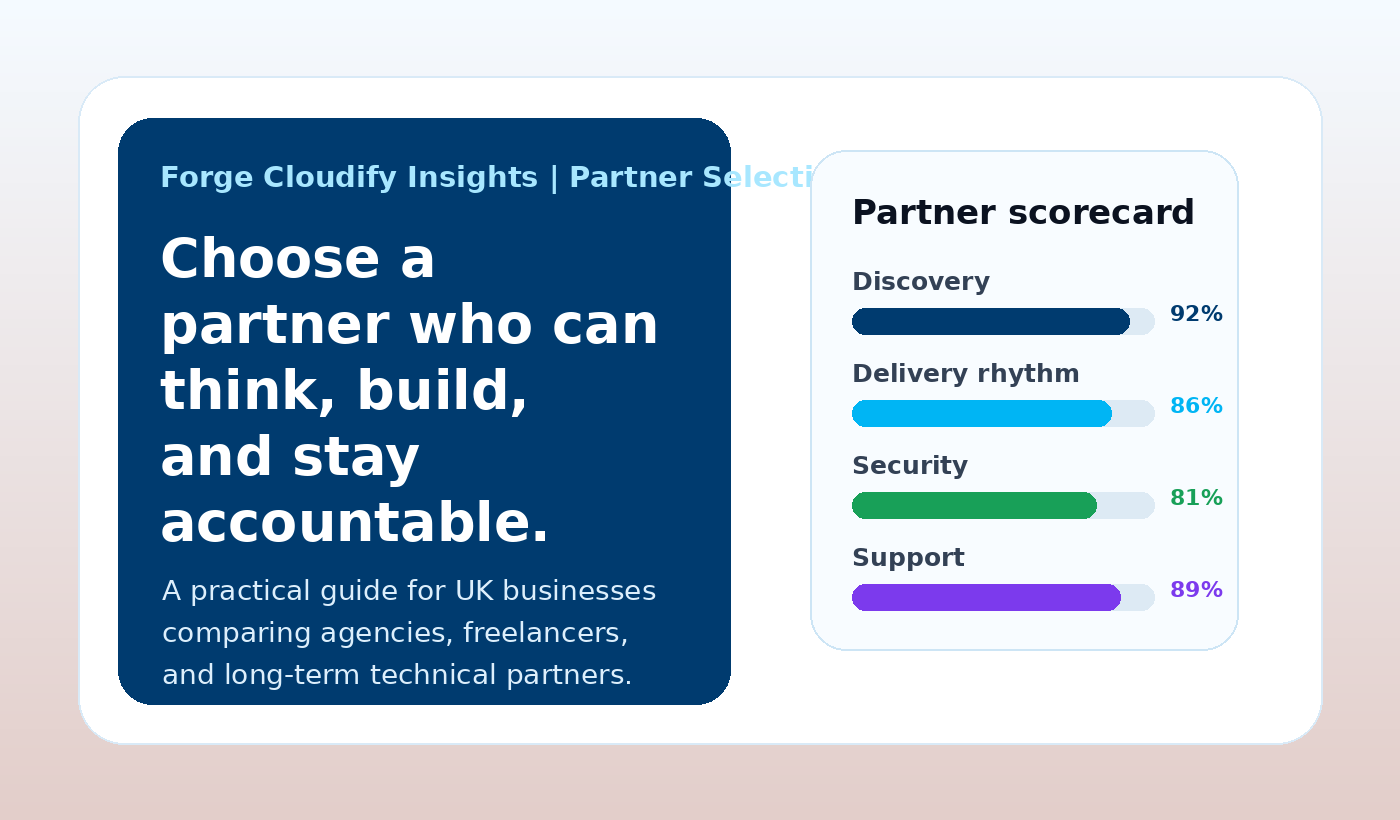
Direct answer: what a good software development partner does
A good software development partner helps a business clarify the problem, choose the right technical route, communicate trade-offs honestly, deliver in visible stages, protect security, and support the product after launch. The strongest partners act like long-term product allies, not just code suppliers working through a task list.
Why the partner matters more than the proposal deck
Many UK businesses compare software suppliers by price, portfolio, and promised delivery date. Those things matter, but they do not reveal how the supplier behaves when requirements are messy, integrations are awkward, or the first version meets real users.
A strong software development partner brings calm structure to that uncertainty. They help decide what should be built now, what can wait, which risks need proof early, and how the system will be maintained after the first release. Forge Cloudify treats that judgement as part of the work, not an optional extra.
Six signs you have found the right development partner
They start with discovery
Before quoting the full build, they ask about users, workflows, data, approvals, integrations, commercial goals, constraints, and what would make the project fail.
They explain trade-offs
A useful partner can compare custom software, SaaS tools, low-code shortcuts, API integrations, and phased MVP delivery without forcing every answer toward a bigger build.
They make delivery visible
You should see progress through milestones, demos, backlog decisions, sprint notes, test results, and clear next steps instead of waiting silently for a final reveal.
They care about maintainability
Good partners think about code quality, documentation, hosting, security, performance, data ownership, and future developers who may need to work on the product.
They challenge weak ideas
If a requested feature adds cost without business value, creates avoidable risk, or distracts from launch, the partner should say so professionally and offer a better route.
They plan aftercare
Launch is not the end. A good partner discusses monitoring, bug fixes, user feedback, improvement cycles, backups, updates, and ownership before the product goes live.
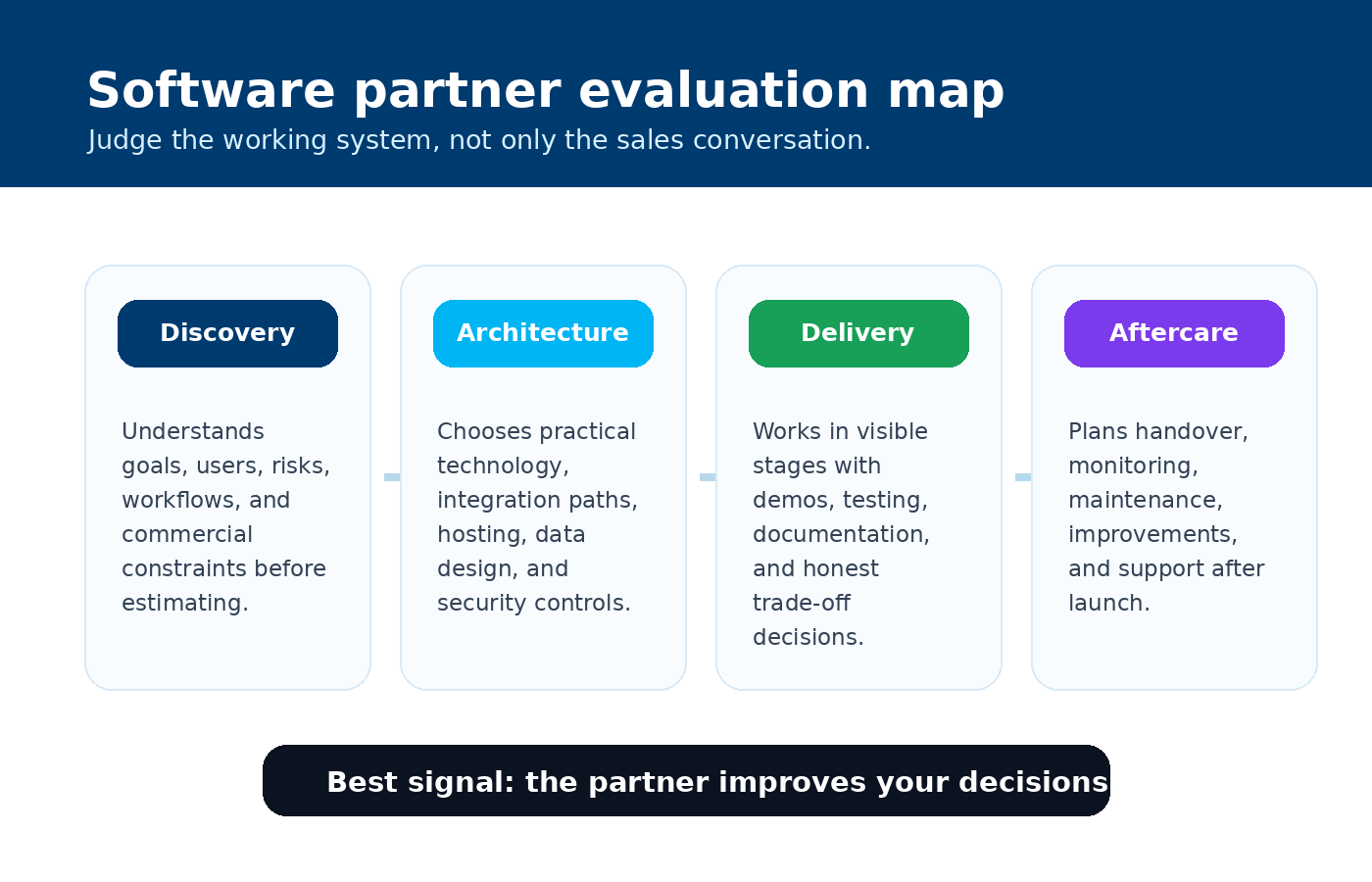
Checklist before signing a software development agreement
Forge Cloudify’s partnership process
A good process protects both sides. It gives the client enough visibility to make decisions and gives the delivery team enough clarity to build properly.
Understand the business case
We map the workflow, commercial goal, user groups, current tools, data sources, integration needs, constraints, and success measures.
Shape the right solution
We define the practical route: custom build, SaaS MVP, AI feature, API integration, internal tool, modernization project, or phased roadmap.
Deliver in controlled stages
We move through design, architecture, development, testing, demos, feedback, deployment, and documentation with visible checkpoints.
Support and improve
After launch, we help monitor behaviour, fix issues, review feedback, plan improvements, and keep the product aligned with the business.
Good partner vs risky supplier
| Area | Good software development partner | Risky supplier |
|---|---|---|
| Discovery | Asks detailed questions, validates assumptions, and turns vague goals into a practical delivery plan. | Quotes quickly from a short brief and treats uncertainty as something to handle later. |
| Communication | Explains decisions plainly, shares progress, flags risks early, and gives useful options. | Goes quiet between milestones, hides problems, or relies on technical language to avoid accountability. |
| Technical quality | Builds for maintainability, security, performance, ownership, and future change. | Focuses only on surface features and leaves fragile hosting, undocumented logic, or inaccessible code. |
| Long-term value | Helps the product evolve through feedback, support, analytics, and a roadmap. | Disappears after launch or makes every small improvement feel like a brand-new project. |
Questions UK businesses should ask before choosing
Ask how the partner handles unclear requirements, changing scope, third-party integrations, technical debt, testing, security, hosting, accessibility, documentation, and support. Ask who will own the source code, how estimates are created, what happens if the project needs to pause, and how decisions are recorded.
Most importantly, ask what they would not build first. A partner who can reduce scope intelligently is often more valuable than a supplier who agrees to every idea and quietly lets the budget absorb the damage.
Need a partner who can shape and build the right system?
Forge Cloudify helps UK businesses plan, build, integrate, and improve custom software, SaaS products, AI features, and operational platforms with practical technical judgement.
Frequently asked questions
What should I look for in a software development partner?
Look for clear discovery, relevant technical experience, honest communication, transparent delivery stages, security awareness, maintainable code practices, post-launch support, and the ability to challenge weak assumptions before they become expensive problems.
Is a software development partner different from a freelancer?
Usually, yes. A partner should provide product thinking, architecture, development, testing, deployment, documentation, and continuity. A freelancer can be excellent for focused tasks, but a business-critical platform often needs broader delivery ownership.
How much should UK businesses budget before speaking to a partner?
You do not need a fixed final budget before the first conversation, but you should know the commercial goal, expected users, must-have workflows, timing pressure, and the cost of doing nothing. A good partner can then shape sensible options.
How can I avoid choosing the wrong software agency?
Avoid suppliers who quote before understanding the workflow, promise everything without trade-offs, hide who will do the work, lack testing or security process, resist documentation, or cannot explain how support will work after launch.
Can Forge Cloudify act as a long-term technical partner?
Yes. Forge Cloudify can help with discovery, custom software, SaaS platforms, AI features, API integrations, cloud delivery, maintenance, and technical roadmaps for businesses that need reliable digital systems.
Related services: Software Development, SaaS Development, AI Development, API Integration, Cloud & DevOps, and All Forge Cloudify Services.