
Building Secure Web Apps: A Practical Checklist for Business Owners
A secure web app is not just a nice interface with a login screen. Business owners need a practical way to confirm that identity, data, code, cloud hosting, monitoring, and recovery have been designed before customers depend on the product.
Direct answer: what secure web app development includes
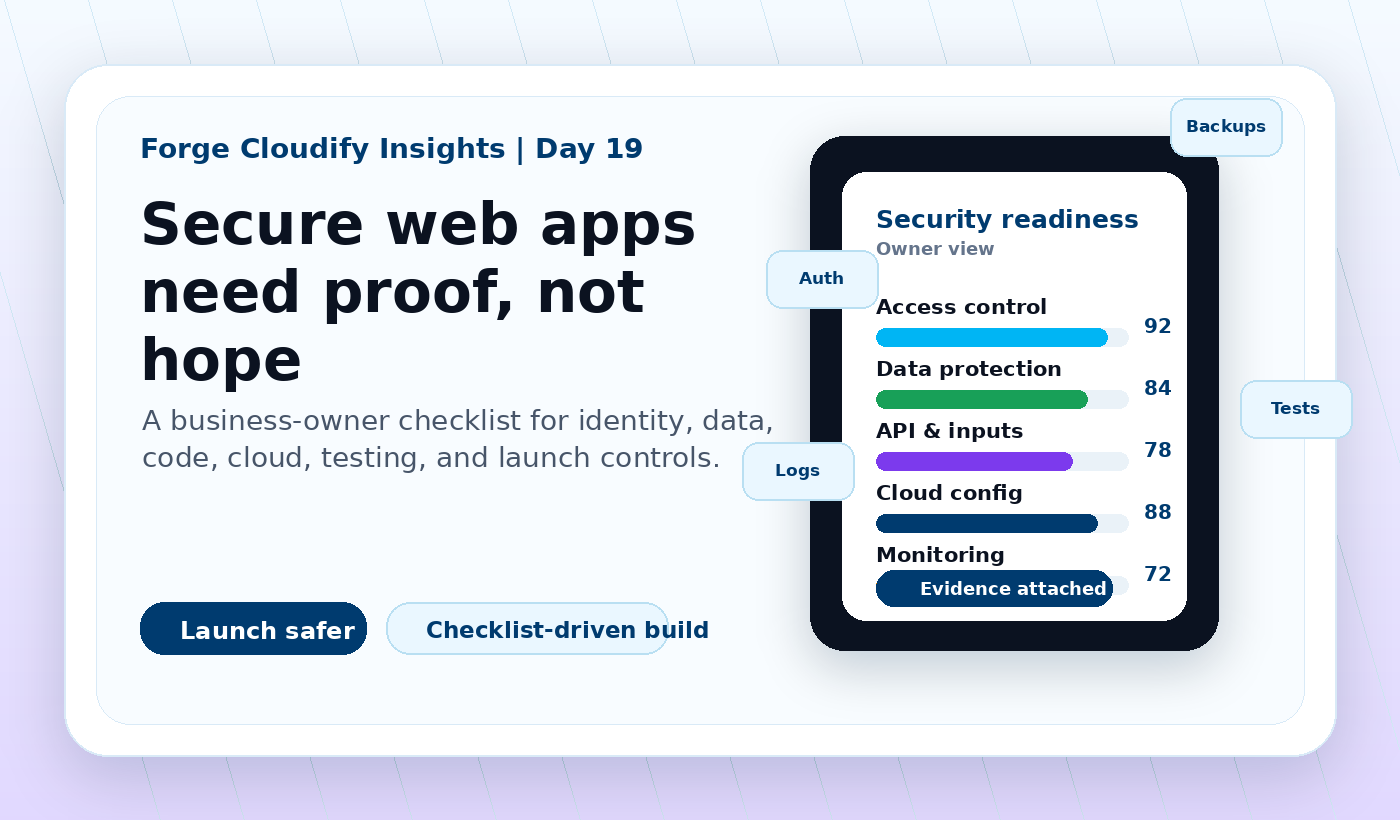
Secure web app development means designing security into requirements, code, infrastructure, data handling, testing, and operations before launch. Business owners should confirm access control, encryption, secure configuration, dependency updates, backups, logging, monitoring, vulnerability testing, incident response, and GDPR-aware data handling are planned, evidenced, and owned.
Security is a business decision before it is a technical task
A web app may hold customer accounts, payment flows, staff permissions, documents, analytics, operational records, or commercially sensitive data. If security is treated as a technical clean-up item at the end, the business can inherit risks that are expensive to fix after launch.
Forge Cloudify’s view is straightforward: business owners do not need to become security engineers, but they do need a clear checklist, named owners, visible evidence, and a development partner who can explain risk in commercial terms. The right question is not “is it secure?” The better question is “which controls are in place, how were they tested, and who keeps them healthy?”
The secure web app checklist
Access and roles
Confirm how users sign in, how multi-factor authentication is handled, which roles exist, and whether every sensitive action checks authorization on the server.
Data protection
Map personal and sensitive data, reduce what is collected, encrypt important data in transit and where appropriate at rest, and document retention rules.
Input and API safety
Validate input, protect file uploads, control API access, rate-limit risky endpoints, and avoid trusting browser-side checks for business-critical decisions.
Secure infrastructure
Use hardened hosting, secret management, least-privilege cloud access, secure defaults, environment separation, backups, and rollback plans.
Testing and review
Plan code review, automated tests, dependency scanning, vulnerability checks, and penetration testing where the data, risk, or customer impact justifies it.
Monitoring and response
Log important events, monitor errors and suspicious behaviour, define alert ownership, and prepare an incident response route before the first serious issue.
What business owners should ask their development partner
Forge Cloudify’s practical secure-build process
Security does not have to slow a project down when it is planned properly. The aim is to make the secure path the normal path for design, development, deployment, and support.
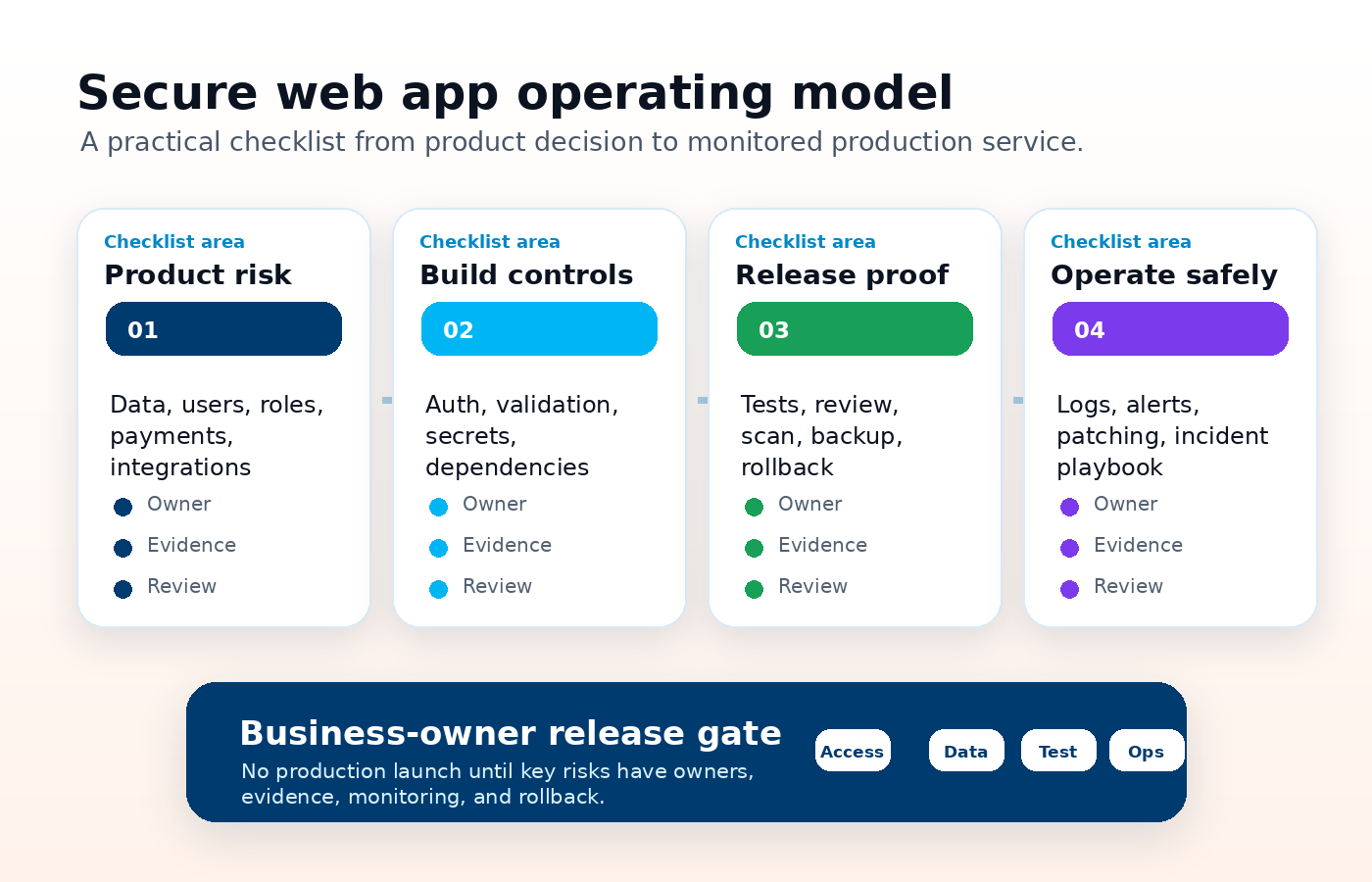
Map risk early
We identify users, roles, data flows, integrations, abuse cases, compliance concerns, and business-critical workflows before architecture decisions are locked in.
Build controls into the product
We implement server-side authorization, input validation, secret handling, audit-friendly logging, secure APIs, and infrastructure controls as part of normal delivery.
Verify before release
We review code, test risky paths, check dependencies, inspect configuration, and prepare launch evidence so the owner understands what has been covered.
Support the live system
We help with monitoring, patching, backups, incident playbooks, performance visibility, and security improvements as the app grows.
Weak launch vs secure launch
| Area | Weak launch pattern | Secure launch pattern |
|---|---|---|
| Ownership | Security is assumed to be “handled by developers” with no visible checklist or evidence. | Security controls, risks, and post-launch responsibilities are documented and reviewed. |
| Access | Roles are vague, admin access is broad, and permissions are tested only through the UI. | Roles are explicit, privileged access is limited, and server-side authorization is tested. |
| Data | The app collects more data than needed and stores it without clear retention or protection rules. | Data flows are mapped, collection is purposeful, and protection aligns with business and GDPR risk. |
| Operations | Backups, logs, updates, and alerts are discussed after something goes wrong. | Monitoring, backups, rollback, patching, and incident response exist before customers rely on the app. |
When to invest more heavily in security
A simple brochure-style website and a customer portal do not need the same level of security engineering. More care is needed when the product stores personal data, controls payments, exposes APIs, supports staff operations, integrates with finance or CRM tools, uses AI on customer data, or gives different users different permissions.
For many UK businesses, the right first step is a security-focused product review before development begins. That review can turn vague worry into practical decisions: what must be built now, what can be phased later, what needs independent testing, and what operational support will be required after launch.
Building a web app customers can trust?
Forge Cloudify can help plan, build, review, deploy, and support a secure web application with practical controls around identity, data, APIs, cloud infrastructure, testing, and monitoring.
Frequently asked questions
What is secure web app development?
Secure web app development is the practice of building an application so security is considered from planning through design, coding, testing, deployment, monitoring, and maintenance rather than added at the end.
What should business owners check before launching a web app?
Owners should check authentication, authorization, data protection, backups, hosting configuration, dependency patching, input validation, payment or API security, logging, monitoring, vulnerability testing, and a clear incident response process.
Does every web app need penetration testing?
Not every small internal tool needs the same level of testing as a financial platform, but every production web app should have security review. Apps handling sensitive data, payments, customer accounts, or business-critical workflows usually deserve independent penetration testing before major launch.
How does OWASP help with web app security?
OWASP gives practical references such as the Top 10 risk awareness list and ASVS verification standard. They help teams discuss common risk areas, set security requirements, and test whether controls are actually present.
Can Forge Cloudify build or review a secure web app?
Yes. Forge Cloudify can design, build, review, modernize, and deploy secure web applications with practical controls around identity, data, APIs, infrastructure, testing, and ongoing support.
Related services: Software Development, Cloud & DevOps, Website Development, AI Development, Project Estimate, and All Forge Cloudify Services.