
Fractional CTO vs Software Development Agency: What Should a UK SME Hire?
Choose the operating model that closes your real capability gap: direction, delivery, or both.

The direct answer
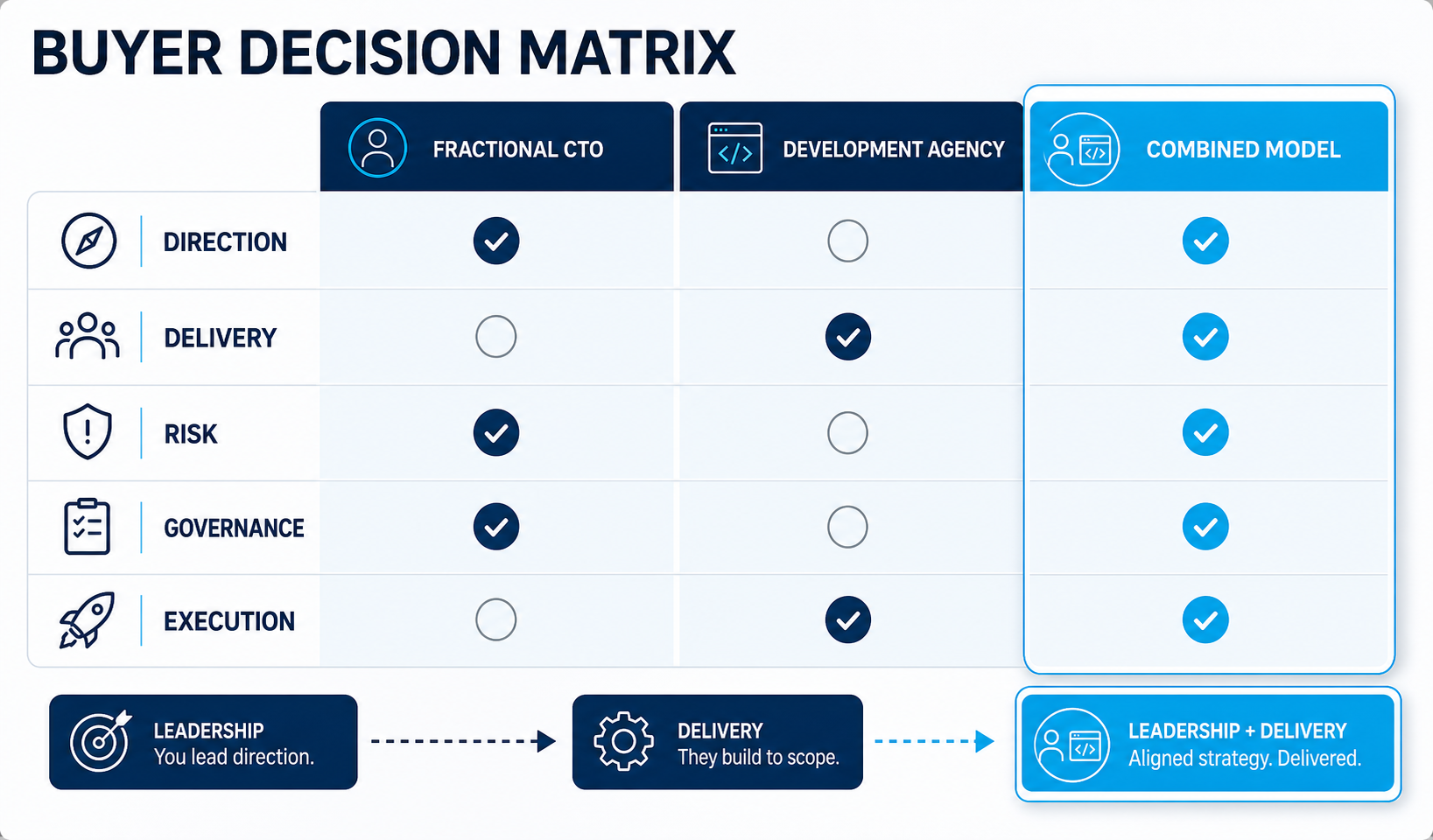
Hire a fractional CTO when your main gap is technology direction, architecture governance, supplier oversight or executive decision-making. Hire a software development agency when the direction is clear but you need a capable delivery team. UK SMEs with both gaps often need a combined model: independent leadership paired with accountable engineering capacity.
The job titles are less important than the missing capability. A senior adviser who only writes a roadmap cannot compensate for absent engineering capacity. A strong delivery team cannot safely invent board-level priorities, risk appetite and investment decisions on the buyer’s behalf.
For UK buyers, useful procurement criteria include user needs, accessibility, security, open standards, sustainability and whole-life cost—the themes set out in the UK Government Technology Code of Practice. NCSC guidance also treats security as part of development, reinforcing why responsibility must be explicit from planning through operation.
Six responsibilities to assign before you hire
Technology direction
A fractional CTO turns business priorities into technology principles, investment choices and a sequenced roadmap. This is leadership work, not a backlog of coding tasks.
Architecture and risk
Senior oversight challenges platform, data, integration, security and continuity decisions before they create expensive lock-in or operational exposure.
Supplier governance
Leadership defines decision rights, acceptance criteria and reporting, then challenges delivery evidence without becoming another layer of ceremony.
Multidisciplinary delivery
An agency brings product, UX, engineering, QA, cloud and delivery capability that can move from validated scope to working software.
Specialist capacity
Agencies can add skills for a defined stage or outcome without asking an SME to recruit every discipline permanently.
Operational ownership
Neither model replaces accountable business ownership. Your SME must own outcomes, priorities, data decisions, adoption and the final risk acceptance.
Signals that reveal the right model
A four-step buying process
Design the engagement around accountable decisions and evidence. The right blend may change as uncertainty falls, delivery accelerates and internal capability grows.
Diagnose the missing capability
List the decisions that are delayed, the outcomes at risk and the skills or capacity unavailable internally. Separate leadership gaps from execution gaps.
Define decision rights
Name who owns product priorities, architecture, security risk, budget, supplier management and acceptance. Prevent the fractional CTO and agency lead from duplicating authority.
Buy an outcome and evidence
Set measurable outcomes, review gates, delivery evidence and escalation routes. Evaluate relevant experience, working practices, security and knowledge-transfer plans.
Review the operating model
Track decision speed, roadmap confidence, delivery predictability, quality and internal capability. Change the blend as the product and permanent team mature.
Compare the three operating models
| Buying criterion | Best-fit model | Watch-out |
|---|---|---|
| Direction is missing | Fractional CTO | Do not mistake advice for delivery capacity |
| Delivery capacity is missing | Development agency | Buyer still owns priorities and risk acceptance |
| Both gaps exist | Combined model | Define boundaries between leadership and delivery |
| Core capability is strategic | Use external help while building an internal team | Avoid permanent dependency and undocumented knowledge |
| Short, defined outcome | Specialist agency engagement | Specify acceptance, handover and operational ownership |
Build the operating model before buying the work
Forge Cloudify can help UK SMEs clarify technology direction, shape a delivery roadmap and provide accountable software, AI and cloud engineering around defined business outcomes.
Frequently asked questions
What is the difference between a fractional CTO and a development agency?
A fractional CTO provides part-time senior technology leadership: strategy, architecture direction, risk, governance, budgets and supplier oversight. A development agency supplies a multidisciplinary team to design, build, test and operate software against agreed outcomes and scope.
When should a UK SME hire a fractional CTO?
Choose fractional leadership when technology decisions lack a clear owner, suppliers need oversight, architecture or security risk is rising, or the board needs a credible roadmap before funding delivery.
When is a software development agency the better choice?
Choose an agency when priorities, product ownership and decision rights are already clear but internal delivery capacity or specialist skills are missing. The buyer must still provide timely business decisions and accountable ownership.
Can a fractional CTO manage a development agency?
Yes. A fractional CTO can translate business goals into technical direction, evaluate proposals, challenge architecture, manage delivery risks and provide independent acceptance criteria. Keep responsibilities explicit so leadership does not duplicate the agency delivery lead.
Is the combined model always more expensive?
Not necessarily, but it adds a leadership cost. Its value depends on avoiding rework, weak procurement and unmanaged risk. Compare options using total ownership, decision speed, capability gaps and delivery consequences rather than day rates alone.
Related services: Software Development, AI Development, Cloud & DevOps, and Software Development Services.