
Cloud Architecture for Startups: A Practical Guide Before Scaling
A practical guide for founders who need cloud infrastructure that can grow without creating cost, security, or delivery problems too early.
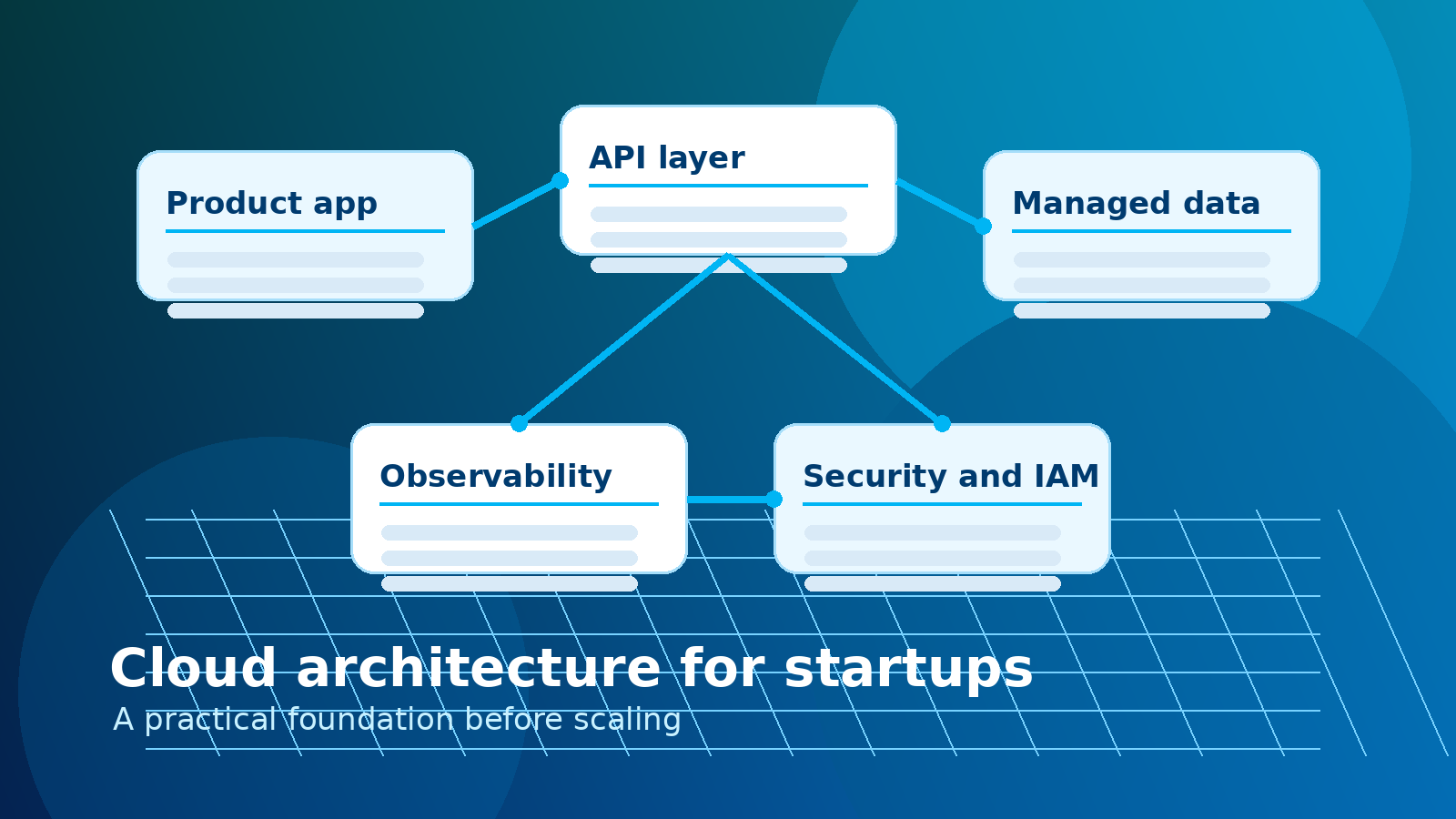
Direct answer: what cloud architecture do startups need before scaling?
Cloud architecture for startups should stay simple, secure, observable, and ready to evolve. Before scaling, founders need clear environments, identity controls, backups, monitoring, cost visibility, deployment discipline, and a roadmap for when to split services, strengthen data layers, and add resilience without over-engineering too early.
Why architecture matters before growth pressure arrives
A startup does not need a complicated cloud estate on day one. It does need a product foundation that is understandable, recoverable, secure enough for customers, and easy to change. The expensive cloud problems usually appear when early shortcuts become invisible dependencies: everyone deploys differently, production access is too broad, backups are assumed rather than tested, and no one knows which service caused the bill to jump.
Forge Cloudify’s view is simple: cloud architecture should make the next stage easier. For an MVP, that means fast delivery with sensible guardrails. For a growing SaaS product, it means clearer ownership, deployment pipelines, observability, data protection, and scaling decisions based on evidence rather than panic.
Six cloud decisions founders should make early
Platform choice
Choose a cloud platform your team or partner can operate well. AWS, Azure, Google Cloud, and managed platforms can all work, but confidence, support, compliance needs, and available skills matter more than brand names.
Environment setup
Separate development, staging, and production so experiments do not put customers at risk. Even a small product benefits from predictable releases and clean configuration management.
Identity and access
Use individual accounts, role-based access, protected secrets, and least privilege. Shared admin logins feel quick early, but they become a security and accountability problem as soon as the team grows.
Data foundation
Plan databases, storage, backups, migrations, and recovery around the data customers would hate to lose. Start simple, but know how data will be restored, audited, and moved as the product matures.
Observability
Logs, metrics, alerts, uptime checks, and error tracking should arrive before scale. If users report issues before your system does, the architecture is already costing trust.
Cost ownership
Budgets, alerts, resource tagging, right-sizing, and routine review keep cloud spend visible. Startups should avoid both underbuilt systems and silent over-provisioning.
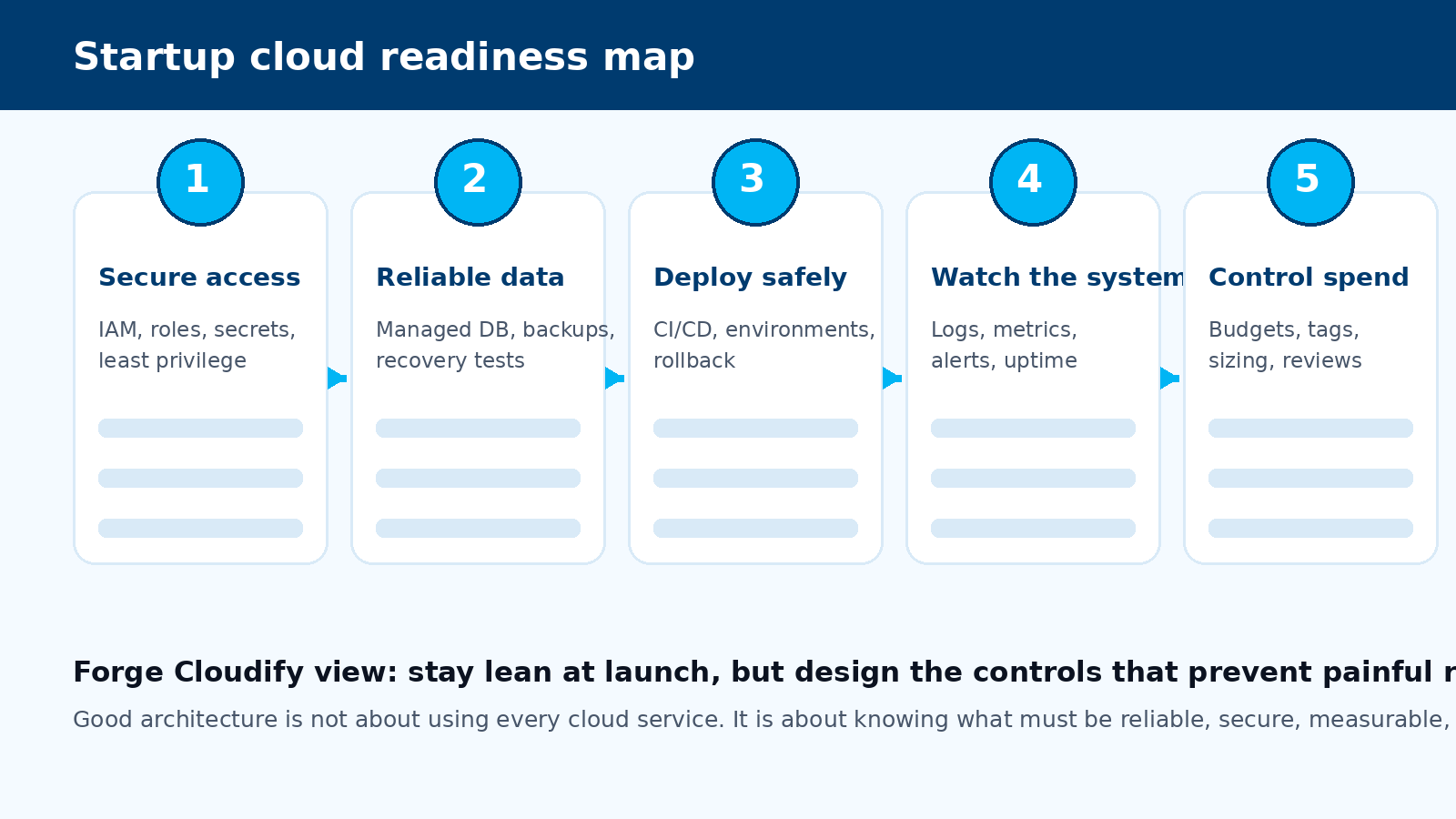
Cloud readiness checklist before scaling
How Forge Cloudify plans startup cloud architecture
The strongest architecture is grounded in the product stage. A startup selling to its first users needs different decisions from a funded SaaS company preparing for enterprise customers. Forge Cloudify scopes the foundation around user risk, data risk, delivery speed, operating cost, and the next credible growth milestone.
Map the product and risk
We review user journeys, data sensitivity, uptime expectations, integrations, release pressure, team skills, and what would hurt the business if it failed.
Design the lean foundation
We define environments, hosting, managed services, network boundaries, access rules, secrets, backups, monitoring, and deployment flow without adding unnecessary complexity.
Build the DevOps path
We connect the architecture to real delivery: CI/CD, infrastructure notes, release checks, logging, alerts, documentation, and support routines.
Review and scale by evidence
As usage grows, we assess bottlenecks, reliability targets, security needs, cost movement, and whether the system should split, cache, queue, replicate, or automate more deeply.
Simple launch setup vs scale-ready foundation
| Decision area | Simple launch setup | Scale-ready foundation |
|---|---|---|
| Hosting | One managed application environment with straightforward deployment and modest resources. | Clear environments, automated deployment, capacity plan, and documented scaling triggers. |
| Data | Managed database, basic backups, and careful schema changes. | Recovery testing, migration discipline, audit needs, retention rules, and read/write scaling plan. |
| Security | HTTPS, protected secrets, limited admin access, and dependency updates. | Role-based access, audit logs, network controls, vulnerability review, and compliance alignment. |
| Operations | Basic logs, error tracking, uptime checks, and manual review. | Metrics, alert thresholds, runbooks, incident ownership, performance baselines, and cost governance. |
Common cloud mistakes that create rework
The biggest mistake is treating architecture as something to fix after growth. Startups often wait until a demo breaks, a bill spikes, a key person leaves, or a customer asks about security. A better approach is to make small, deliberate choices early: document how the system works, keep access clean, protect data, automate releases where it matters, and review the cloud bill as part of product operations.
That does not mean microservices, Kubernetes, multi-region deployment, or complex event systems on day one. Those can be useful later, but they should answer real scale, reliability, or team problems. For most startups, the winning move is a simple architecture with professional discipline around it.
Need a cloud foundation your startup can grow into?
Forge Cloudify can help you design, build, and improve a cloud architecture that supports your product stage, customer expectations, security needs, and budget.
Frequently asked questions
What is cloud architecture for startups?
Cloud architecture for startups is the structure behind a digital product: hosting, databases, storage, networking, security, monitoring, deployment, backups, and cost controls. The goal is to support today's users while keeping a sensible path for growth.
Should a startup use AWS, Azure, Google Cloud, or another platform?
The right cloud depends on product needs, team experience, customer requirements, integrations, budget, and compliance expectations. Most startups should choose a platform the team can operate confidently instead of chasing every advanced service early.
When should a startup move from simple hosting to a cloud architecture?
Move when the product needs reliable deployments, separate environments, stronger security, managed databases, monitoring, backups, integrations, or predictable scaling. The shift should be planned before growth makes downtime and rework expensive.
How can startups control cloud costs before scaling?
Start with budgets, alerts, right-sized resources, managed services used deliberately, clean environments, storage lifecycle rules, and regular cost reviews. Cost control is much easier when ownership and tagging are designed early.
Does Forge Cloudify help startups design cloud architecture?
Yes. Forge Cloudify helps startups plan cloud infrastructure, DevOps workflows, SaaS foundations, API integrations, monitoring, security basics, and scalable product architecture that fits the stage of the business.
Related services: Cloud & DevOps, Software Development, Project Estimate, AI Development.