
Bespoke Software for Operations: When Spreadsheets Stop Working
Spreadsheets are brilliant until they quietly become the operating system for the business. The warning sign is not that the file is large. It is that the company now depends on manual tabs, copied rows, hidden formulas, and human memory to keep work moving.
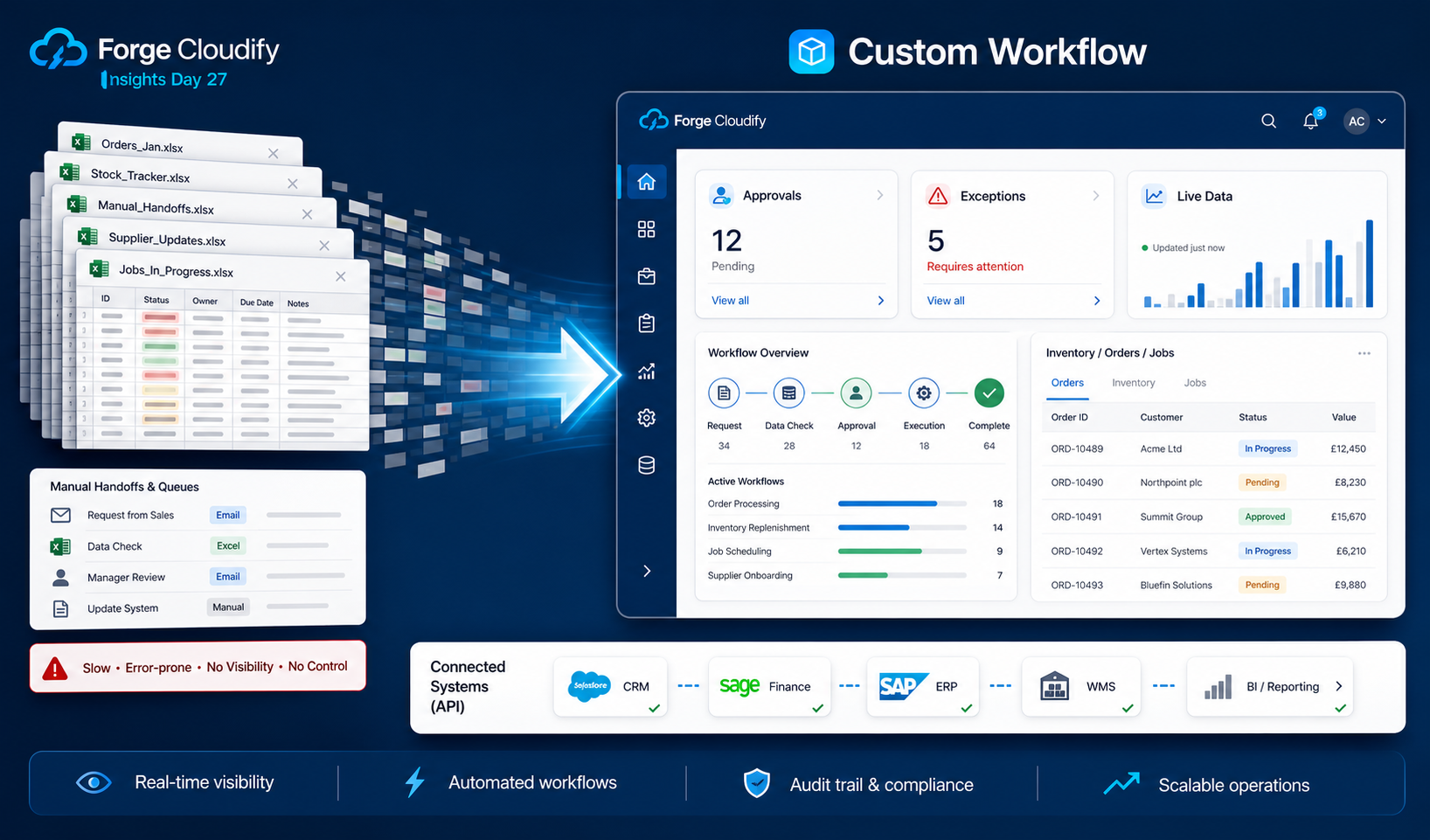
Direct answer: when spreadsheets stop working
Spreadsheets stop working as an operations system when volume, collaboration, rules, approvals, integrations, and audit needs outgrow a file. Bespoke software becomes the better route when the business needs controlled workflows, role-based access, reliable data, live reporting, and integrations with CRM, finance, stock, or fulfilment tools.
The spreadsheet is not the problem. The dependency is.
Most growing businesses do not choose spreadsheet chaos deliberately. It starts sensibly: one tracker for orders, one sheet for stock, one shared file for jobs, one tab for supplier updates, one formula that saves someone an hour every Friday. The spreadsheet is fast, familiar, cheap, and flexible.
The trouble begins when the file stops being a helpful working document and becomes the place where operations actually happen. People chase the latest version. Staff overwrite cells. Managers ask for manual reports. Teams copy the same data into CRM, finance, fulfilment, and email. The business still works, but only because people are filling the gaps the system should own.
Forge Cloudify does not see bespoke software as software for software’s sake. We see it as a way to give a business the control, visibility, and repeatability it needs once spreadsheet-driven operations start holding growth back.
Six signs you have outgrown spreadsheets
Several people edit the same process
When sales, operations, finance, and management all depend on one file, confusion becomes normal. Bespoke software can separate roles, permissions, statuses, and responsibilities without breaking the shared view.
Status is unclear
If people ask whether a job is received, planned, approved, blocked, delivered, invoiced, or closed, the workflow needs explicit stages rather than colour-coded rows and comments.
Rules live in people’s heads
Discount limits, approval thresholds, stock rules, escalation paths, and customer exceptions should not depend on who remembers them. Software can enforce the rules consistently.
Manual rekeying is everywhere
When the same data moves from spreadsheet to CRM, finance, inventory, email, and reporting tools, the business is paying for repeated admin and accepting avoidable errors.
Reporting is late or disputed
If leaders wait for someone to clean data before they can see orders, capacity, revenue, risk, or delivery performance, the workflow needs live reporting from a trusted source.
Audit and accountability are weak
Operational software can record who changed what, when approvals happened, which exceptions were overridden, and why a decision was made. That matters when work becomes critical.
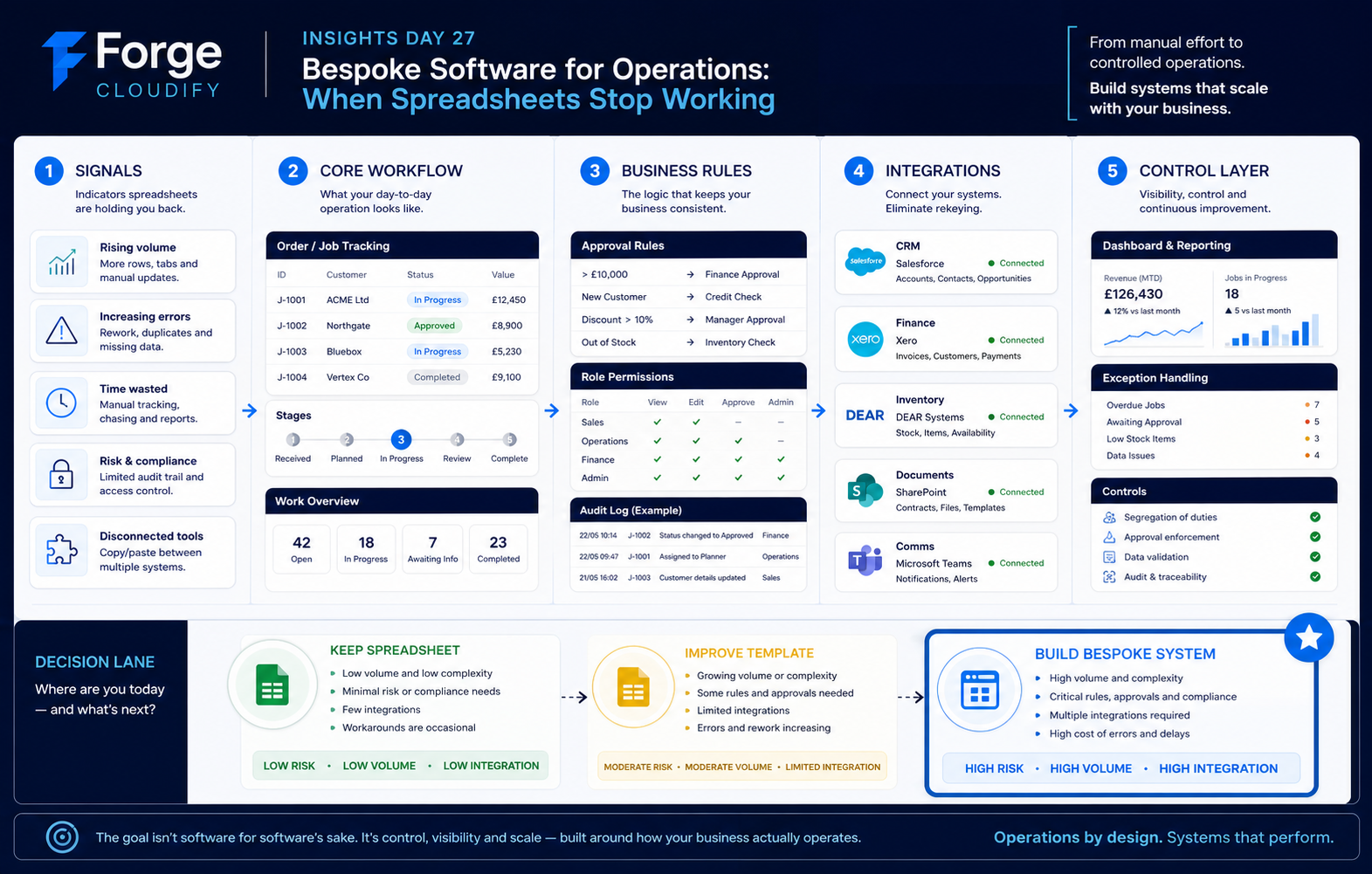
Bespoke operations software readiness checklist
Forge Cloudify’s build process
A good bespoke system starts with the real operation, not a feature wishlist. The goal is to understand how work moves today, where it breaks, which rules matter, and which parts should be automated, integrated, or kept deliberately human.
Map the live workflow
We document users, statuses, handoffs, fields, reports, approvals, exceptions, integrations, pain points, and the spreadsheet logic the business currently relies on.
Design the operating model
We define the future workflow: roles, permissions, data model, rules, notifications, audit events, dashboards, and API connections to the systems already in use.
Build the first controlled version
We develop the core web app or internal portal in focused phases, prioritising the workflow that creates the clearest operational benefit first.
Launch, measure, and expand
We support rollout, staff adoption, data migration where needed, monitoring, feedback, and future modules once the first workflow is stable.
Spreadsheet, no-code tool, or bespoke software?
| Option | Best fit | Risk if stretched too far |
|---|---|---|
| Keep the spreadsheet | Low-volume work, one owner, simple tracking, limited risk, few integrations, and occasional manual updates. | The file becomes a hidden system with unclear ownership, fragile formulas, and growing dependency. |
| Improve with templates or no-code | Moderate complexity, basic forms, simple approvals, lightweight automation, and teams that can adapt to standard tool limits. | The workaround layer can become harder to govern if it grows without architecture, permissions, and data discipline. |
| Build bespoke software | High-value operations with volume, rules, roles, audit needs, reporting, integrations, and process logic that should match the business. | The project needs clear scoping and staged delivery so the system solves real operational pain rather than becoming a large wish list. |
What a bespoke operations system usually includes
For many UK businesses, the first useful system is not a giant ERP replacement. It is a focused operational layer that turns spreadsheet work into a controlled flow: requests come in, records are created, statuses move forward, rules are checked, approvals happen, exceptions are visible, and data syncs to the right tools.
That may include customer or order records, job scheduling, supplier updates, stock checks, document uploads, quote approval, finance handoff, manager dashboards, email notifications, role-based access, and a searchable history of actions. The shape should follow the business, not the other way around.
How to avoid overbuilding
The safest starting point is a narrow operational workflow with obvious value. Pick the spreadsheet process that creates the most repeated manual work, reporting delay, customer friction, compliance worry, or growth constraint. Build that workflow well, measure adoption, then expand from a proven foundation.
A bespoke system should remove operational pressure. It should not recreate every spreadsheet tab because every tab exists today. Some fields are useful. Some are historic clutter. Some formulas are workarounds for missing process design. Good discovery separates the business-critical rules from the habits that no longer serve the company.
Ready to turn spreadsheet operations into a controlled system?
Forge Cloudify can help map your spreadsheet-driven workflows, design a practical operating model, build secure bespoke software, and connect it to the tools your business already depends on.
Frequently asked questions
When should a business replace spreadsheets with bespoke software?
Replace spreadsheets when they control important operational work, need several people editing at once, contain hidden business rules, cause rekeying between systems, create reporting delays, or lack a reliable audit trail for changes and approvals.
Is bespoke software better than improving our spreadsheet?
Not always. A cleaner spreadsheet or no-code tool may be enough for low-volume work. Bespoke software makes sense when the process is valuable, repeatable, cross-team, rule-heavy, integration-heavy, or too risky to manage through manual files.
What operations can bespoke software manage?
Common examples include order tracking, job scheduling, approvals, stock movement, supplier updates, customer onboarding, service delivery, compliance checks, internal reporting, and workflow handoffs between sales, finance, operations, and management.
How do you plan bespoke operational software safely?
Start by mapping the real workflow, users, data fields, rules, exceptions, integrations, reports, and security needs. Then build the first controlled workflow in phases so teams can test, adopt, and improve it before expanding.
Can Forge Cloudify build bespoke software for operations?
Yes. Forge Cloudify can map spreadsheet-driven workflows, design the operating model, build secure web apps or internal portals, integrate business systems, and create dashboards that give UK teams better control over daily operations.
Related services: Software Development, AI Development, Cloud & DevOps, ERP Development, Project Estimate, and All Forge Cloudify Services.