
AI Proof of Concept vs Pilot: What Should a UK Business Fund?
Separate feasibility evidence from live-operating evidence, so your next AI investment earns a clear go, redesign or stop decision.
The direct answer
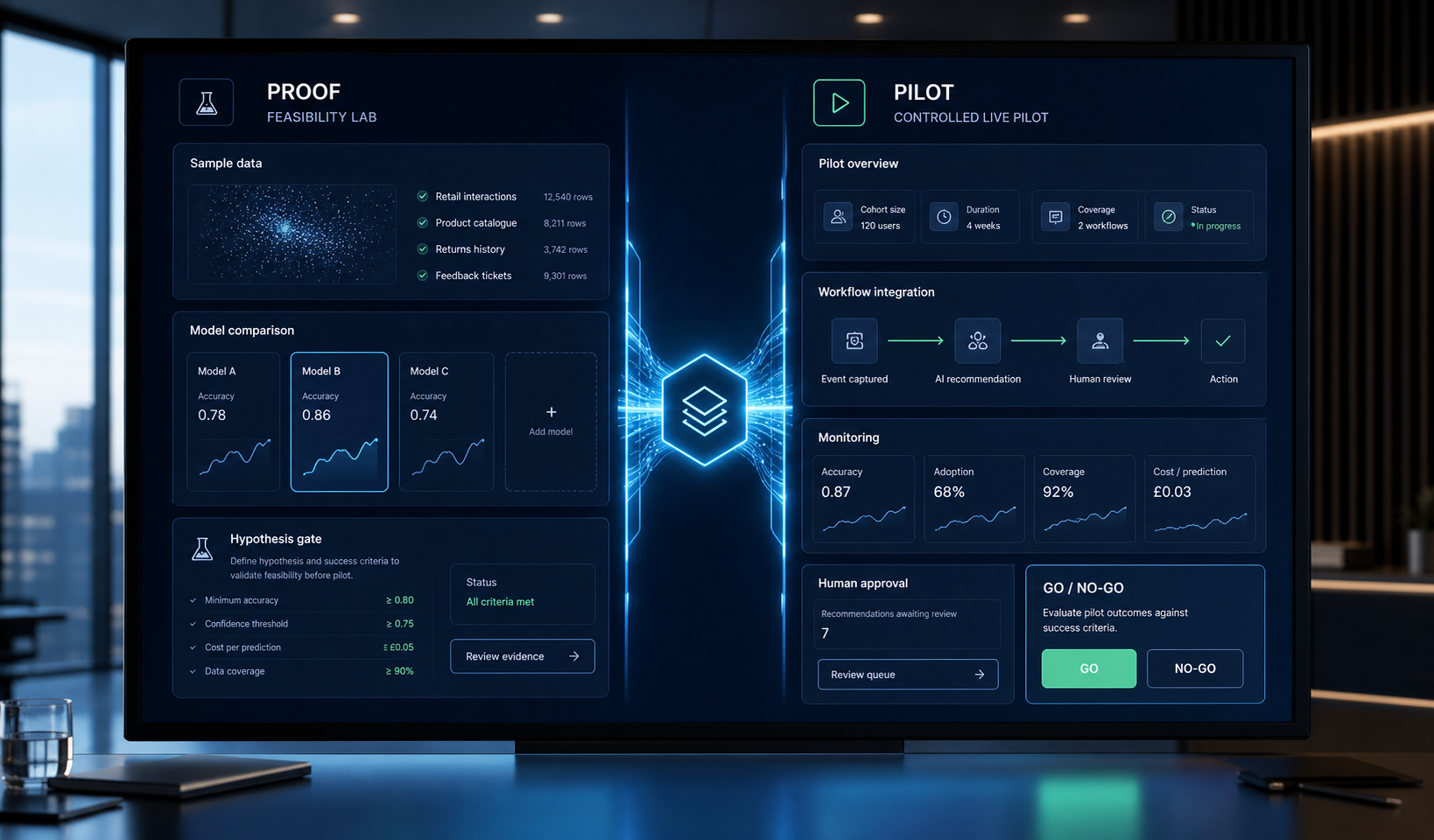
Fund a proof of concept when the central uncertainty is technical feasibility: can the approach work on representative data under defined conditions? Fund a pilot when feasibility is credible but you still need evidence from real users, live workflows, controls and operating costs. Neither phase is a miniature production launch; each needs explicit success, stop and escalation criteria.
UK government guidance recommends using a small-scale proof of concept to test a hypothesis and strengthen the business case. Its AI procurement guidance also supports staged, challenge-led buying: discovery and proof phases can establish whether an approach is likely to meet wider requirements before it goes live.
A pilot answers the questions a lab cannot. It exposes the proposed system to representative users, workflow hand-offs, permissions, exceptions and support demands. NIST’s AI Risk Management Framework reinforces the need to test before deployment and regularly in operation, using documented methods and conditions similar to the intended setting. For personal data, the ICO’s lifecycle guidance means privacy and accountability belong in the design of the test—not in a compliance review after it succeeds.
Six deliverables worth buying
A decision hypothesis
Name the business outcome and the uncertainty being tested. “Try AI” is not a brief; a useful proof states what evidence would support, weaken or reject the idea.
Representative evidence
Use realistic tasks, exceptions and data conditions. A polished demonstration on easy examples says little about reliability in the workflow that matters.
A credible baseline
Compare against today’s process, a rules-based option or an existing tool. Measure value against a real alternative, not against doing nothing.
Failure boundaries
Document errors, unsafe outputs, low-confidence cases and hand-offs. A buyer needs to know where the system stops and a person takes over.
Operating economics
Include integration, model usage, review time, support and monitoring. Prototype accuracy without a plausible operating cost is incomplete evidence.
A written decision gate
Agree scale, redesign and stop thresholds before results arrive. This prevents a visually impressive demo from becoming an unplanned production commitment.
Your phase brief should contain
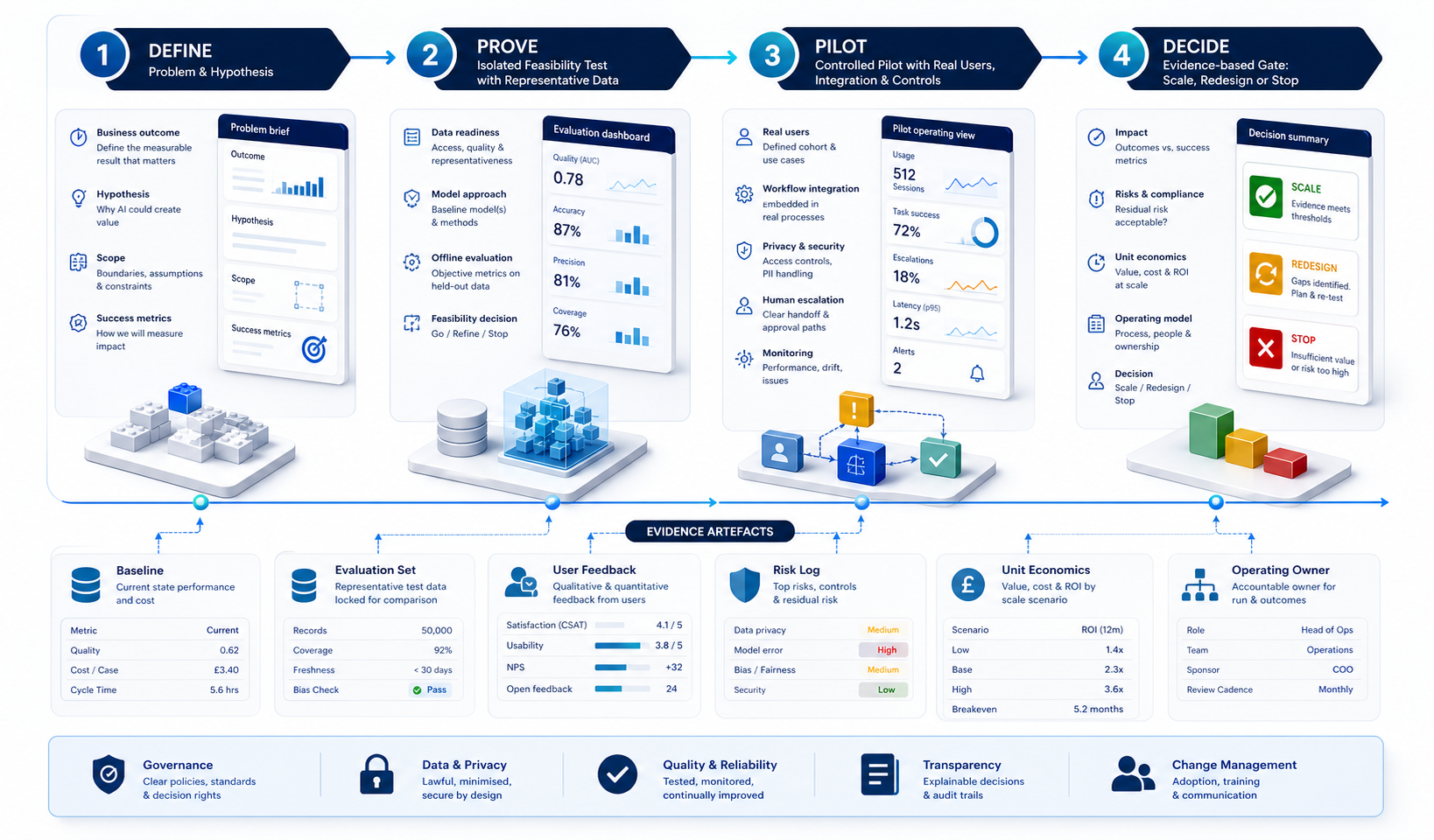
A four-step route from idea to decision
Treat every stage as an evidence contract. The work is complete when the agreed decision can be made—not when the demonstration looks impressive.
Define
Frame the outcome, affected users, current baseline, constraints and the single uncertainty the next investment must reduce.
Prove
Run an isolated feasibility test on a locked evaluation set. Record model, prompt, retrieval, data and test versions so results are reproducible.
Pilot
Connect only what is necessary, limit users and permissions, train participants, monitor failures and capture both measured outcomes and qualitative feedback.
Decide
Review evidence against pre-agreed gates. Scale only with an owned operating model; otherwise redesign the weakest assumption or stop deliberately.
Proof of concept vs pilot: buyer comparison
| Decision area | Proof of concept | Controlled pilot |
|---|---|---|
| Question | Can this approach work? | Does it work responsibly in our operation? |
| Environment | Contained, isolated and reproducible | Limited real users and selected live workflows |
| Evidence | Feasibility, quality, failure modes and indicative cost | Adoption, workflow impact, controls, support and unit economics |
| Integration | Mocks or the minimum needed to test the hypothesis | Controlled connections with least privilege and rollback |
| Exit | Proceed to pilot, redesign the hypothesis or stop | Scale with ownership, redesign gaps or stop |
Buy the evidence your AI decision needs
Forge Cloudify can shape the business case, build a contained proof, design a controlled pilot and leave your team with test results, risk controls and a production-ready decision—not a stranded demo.
Frequently asked questions
What is the difference between an AI proof of concept and a pilot?
A proof of concept tests whether a technical approach can meet a defined hypothesis in a contained setting. A pilot tests a feasible solution with a limited group of real users and workflows, including operational controls, support and monitoring.
Should an AI proof of concept use real business data?
It should use data representative enough to test the hypothesis. Where personal or confidential data is unnecessary, use minimised, masked or synthetic data. If real data is required, define the lawful purpose, access, retention and security controls before use.
How long should an AI pilot run?
There is no responsible universal duration. Run it long enough to observe the target workflow, exceptions, user behaviour and operating burden across representative conditions. Set the review window and decision date before the pilot begins.
What should a go/no-go decision include?
Compare measured outcomes with the agreed baseline and thresholds. Include task quality, user adoption, failure modes, residual risk, workflow impact, security, data protection, support effort, unit economics and a named owner for production.
Can a failed proof of concept still be valuable?
Yes. A well-designed proof can show that the data, model approach or use case is unsuitable before a larger investment. Preserve the evidence, assumptions and failure analysis so the business can stop, redesign or choose a non-AI solution confidently.
Related services: AI Development, Software Development, Cloud & DevOps, and All Forge Cloudify Services.