
AI Governance Framework for UK SMEs: A Practical Buyer’s Guide
Turn scattered AI use into an accountable operating system with clear owners, gates, evidence and monitoring.
The direct answer
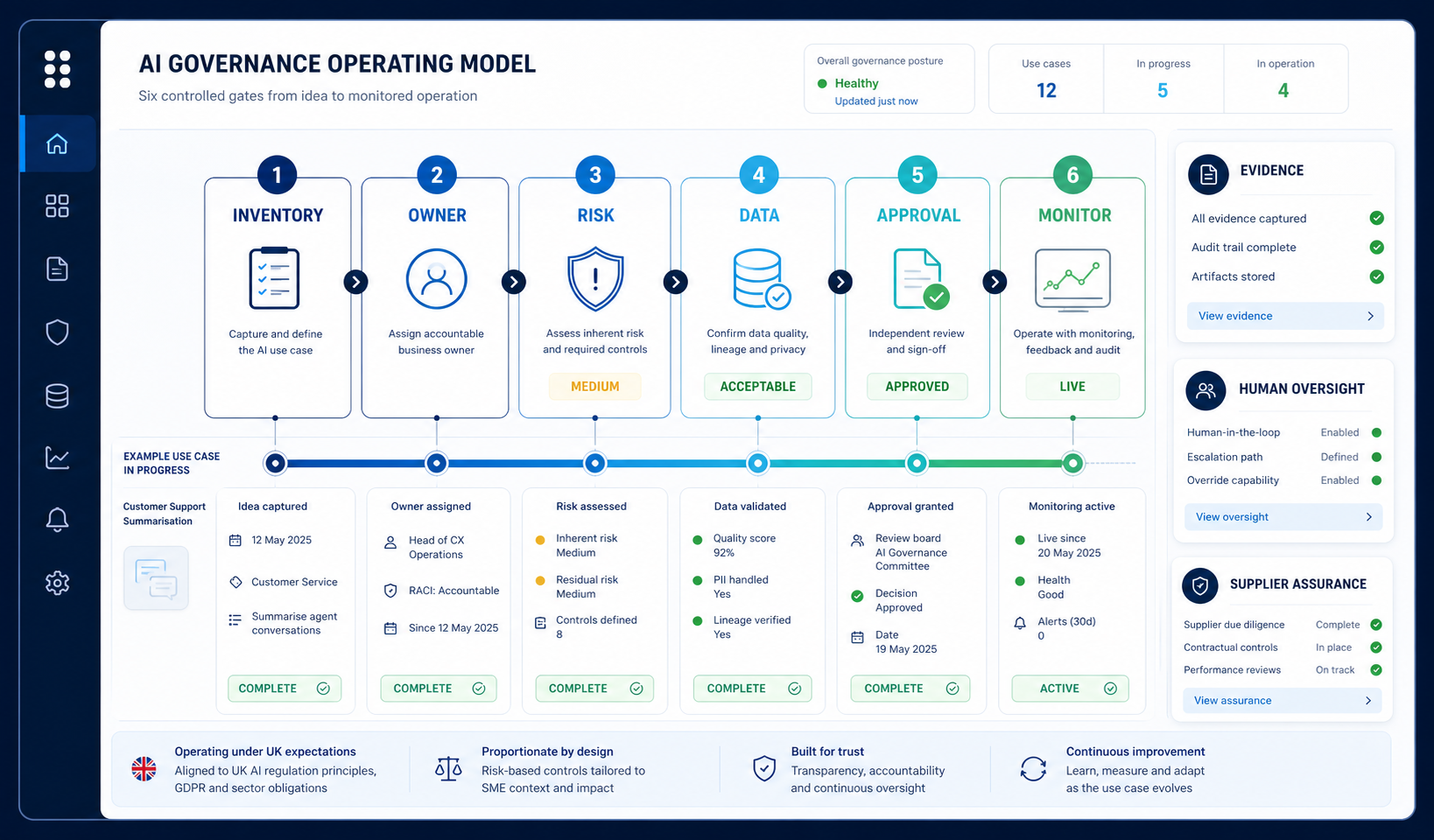
A practical AI governance framework for a UK SME should record every AI system, assign an accountable business owner, classify risk, control data use, assess suppliers, require proportionate approval and monitor live performance. Start with the highest-impact use cases, keep evidence for each decision and make human escalation explicit.
Governance is not a committee that reviews documents after a tool has already spread through the business. It is the operating route from idea to approval, with lightweight paths for low-impact uses and stronger controls where AI can affect people, money, confidential information or essential services.
The UK Government’s AI Management Essentials guidance is aimed primarily at SMEs and start-ups and organises self-assessment around internal processes, risk management and communication. It is a practical starting point, not certification or proof of compliance. ICO guidance adds data-protection risk support, while NCSC guidance covers secure design, development, deployment and operation.
Six controls that make AI governance operational
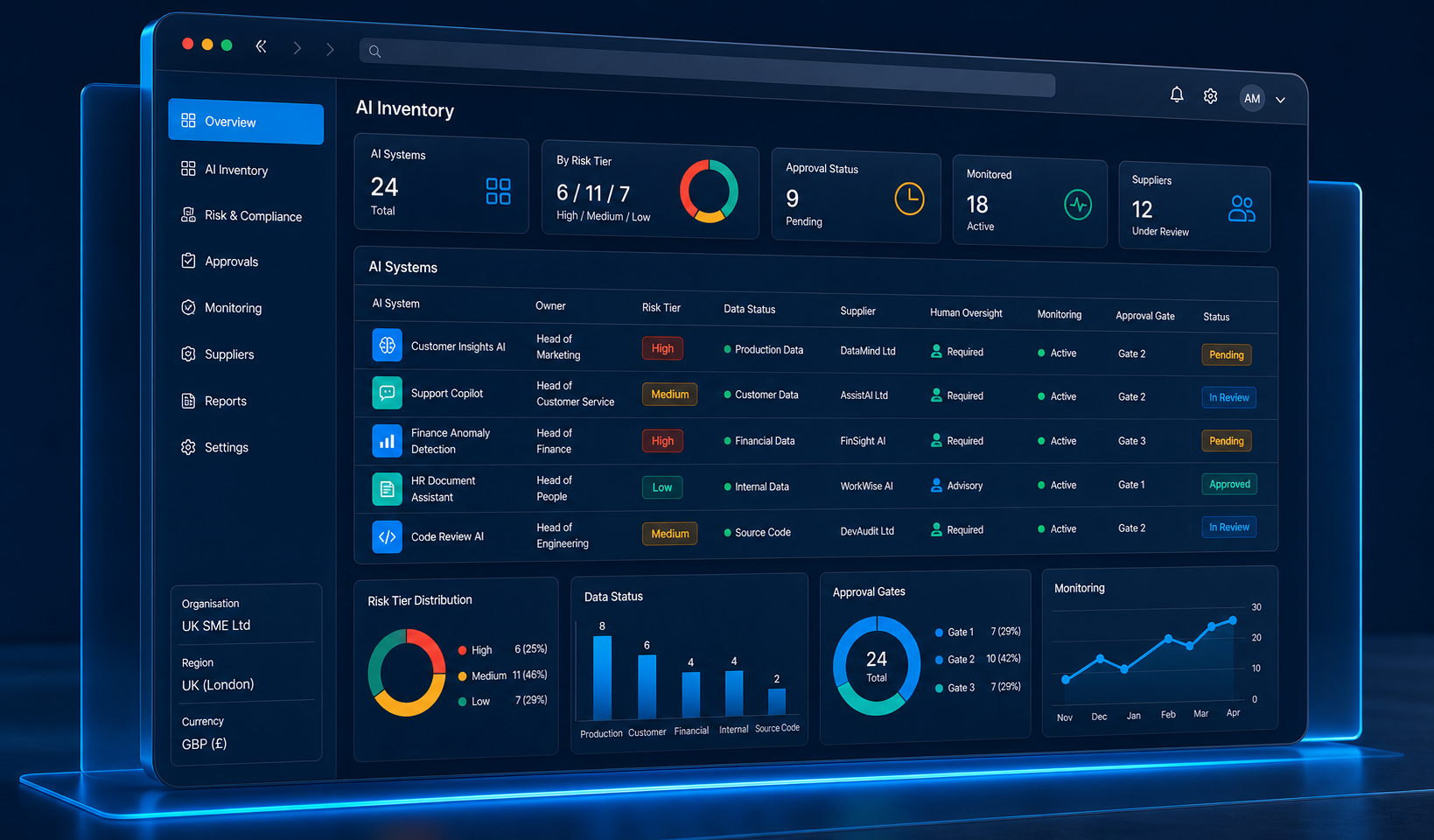
AI system inventory
Keep one record of purchased, embedded and bespoke AI: purpose, owner, users, supplier, data, integrations, risk, controls, approval and next review.
Named accountability
Assign a business owner who can explain the outcome, approve the use case and accept residual risk. Technical teams provide evidence; ownership stays with the business.
Proportionate risk tiers
Classify use cases by impact, autonomy, data sensitivity, affected people and reversibility. Stronger risks receive stronger evidence, testing, oversight and approval.
Data and privacy controls
Document lawful data use, minimisation, quality, retention, access and individual-rights handling. Use the ICO toolkit where personal data and AI intersect.
Supplier assurance
Ask vendors for security, data, model, subcontractor, change, incident and exit evidence. A contract does not remove the buyer’s operational responsibility.
Monitoring and change
Define performance, safety and business measures before launch. Log exceptions, complaints and overrides, then reassess when models, data, suppliers or use cases change.
Your minimum viable governance checklist
A four-step implementation process
Build the smallest system that produces reliable decisions and usable evidence. Expand controls when the impact, autonomy or exposure of a use case increases.
Inventory and prioritise
Find AI already in use across SaaS, pilots, integrations and custom products. Start with use cases that affect customers, employees, money, sensitive data or important operational decisions.
Assign owners and risk tiers
Name the accountable owner and contributors. Assess impact, autonomy, data, security, supplier dependency and failure consequences, then select a proportionate review path.
Build the evidence pack
Capture purpose, data flows, testing, limitations, human oversight, supplier assurance, security controls, acceptance criteria, communications and an escalation plan before approval.
Approve, monitor and improve
Record the decision and residual risk. Track performance and incidents, review material changes, test exit arrangements and retire systems whose benefit no longer justifies their risk or cost.
Compare informal AI adoption with governed adoption
| Decision area | Informal adoption | Governed adoption |
|---|---|---|
| Visibility | Tools discovered through expense or incident | Central inventory with owner and status |
| Risk | Same process for every use case | Tiered evidence and approval by impact |
| Data | Rules depend on individual judgement | Documented purpose, access and retention |
| Suppliers | Marketing claims drive assurance | Evidence, contract controls and exit plan |
| Operations | Approval treated as the finish line | Measures, logs, escalation and review |
Make responsible AI usable, not ceremonial
Forge Cloudify can help your UK business map AI use cases, design proportionate controls, build governance workflows and implement secure AI products with measurable operational oversight.
Frequently asked questions
What is an AI governance framework?
It is the set of policies, roles, records, controls and review processes used to decide which AI systems may be used, how risks are managed and how performance is monitored. It should govern purchased tools as well as systems built in-house.
Does a small UK business need AI governance?
If an SME uses AI in customer, employee, financial or operational workflows, proportionate governance helps it make accountable decisions and retain evidence. The framework can be lightweight, but ownership, data rules, supplier checks and escalation should not be informal.
What should go in an AI system inventory?
Record the purpose, owner, users, affected people, model or supplier, data categories, integrations, risk tier, approval status, controls, monitoring measures, review date and retirement plan for each system.
Should every AI use case need board approval?
No. Approval should be proportionate to impact and risk. Low-risk productivity uses may follow a standard route, while customer decisions, sensitive data, automated actions or safety-critical workflows need stronger scrutiny and named risk acceptance.
Can Forge Cloudify help implement AI governance controls?
Yes. Forge Cloudify can map AI use cases, design governance workflows, build inventories and approval tools, integrate monitoring, implement secure AI systems and create the technical evidence business owners need for ongoing oversight.
Related services: AI Development, Software Development, Cloud & DevOps, Custom Software Development, and AI Development Services.