AI Monitoring for UK Businesses: A Buyer’s Guide
See when AI quality, risk, cost or business value changes—and give the right owner evidence to act.
The direct answer
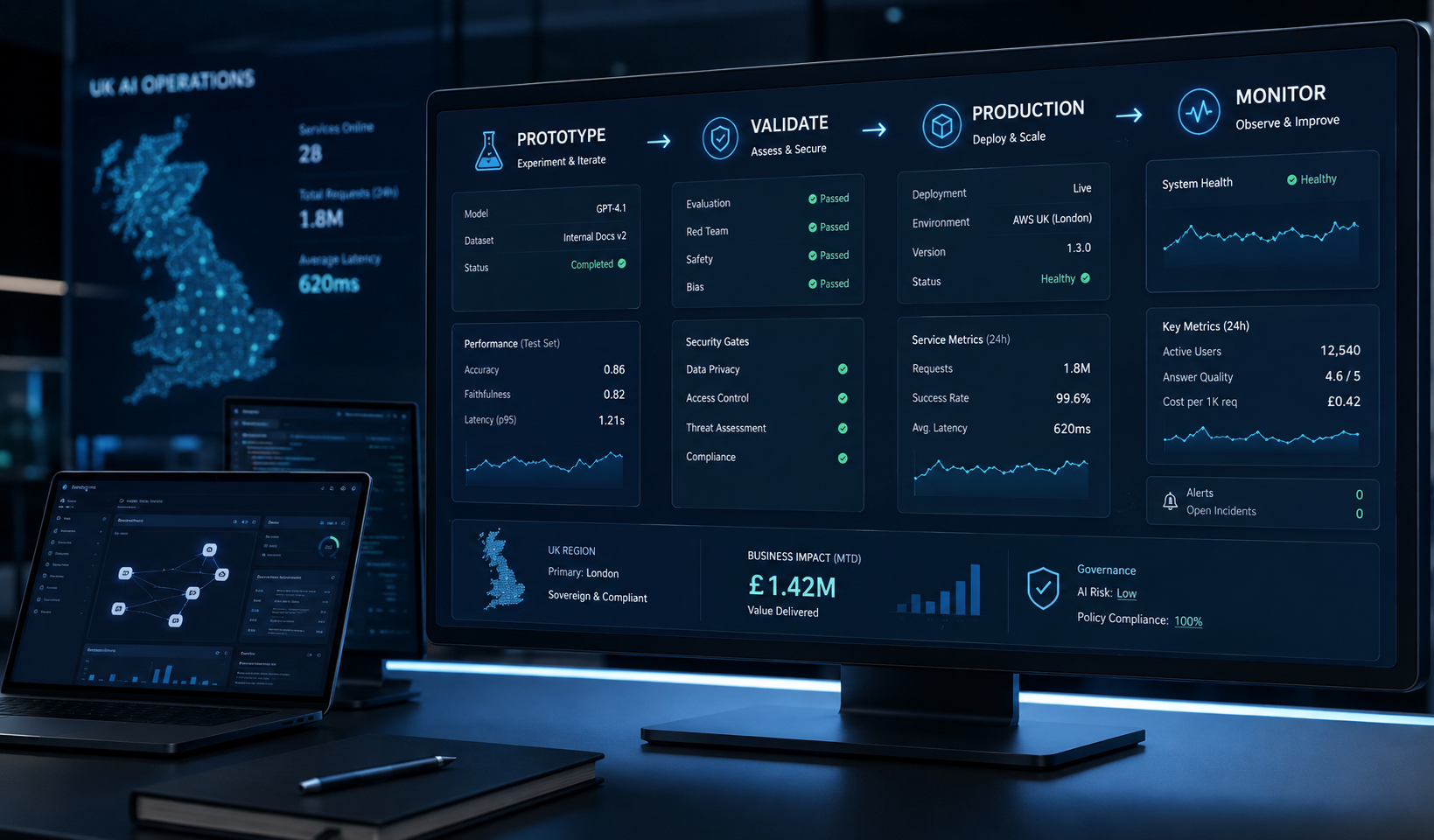
AI monitoring for a UK business should track output quality, safety, data behaviour, security events, latency, availability, usage, unit cost and commercial outcomes. Set thresholds and owners before launch, capture enough evidence to diagnose failures, route serious exceptions to people, and review every material change to models, prompts, data or integrations.
Conventional uptime monitoring cannot tell a buyer whether a plausible AI answer is wrong, whether retrieval quality has degraded, or whether rising human review has erased the business case. Useful AI observability combines technical telemetry, repeatable evaluation and workflow outcomes in one operating view.
For UK buyers, monitoring design should account for data protection, secure AI system operation and proportionate governance. The NCSC includes operation and maintenance in its secure AI lifecycle, while the ICO provides AI and data-protection guidance. Apply controls to the specific use case and obtain specialist advice where required.
Six layers of useful AI monitoring
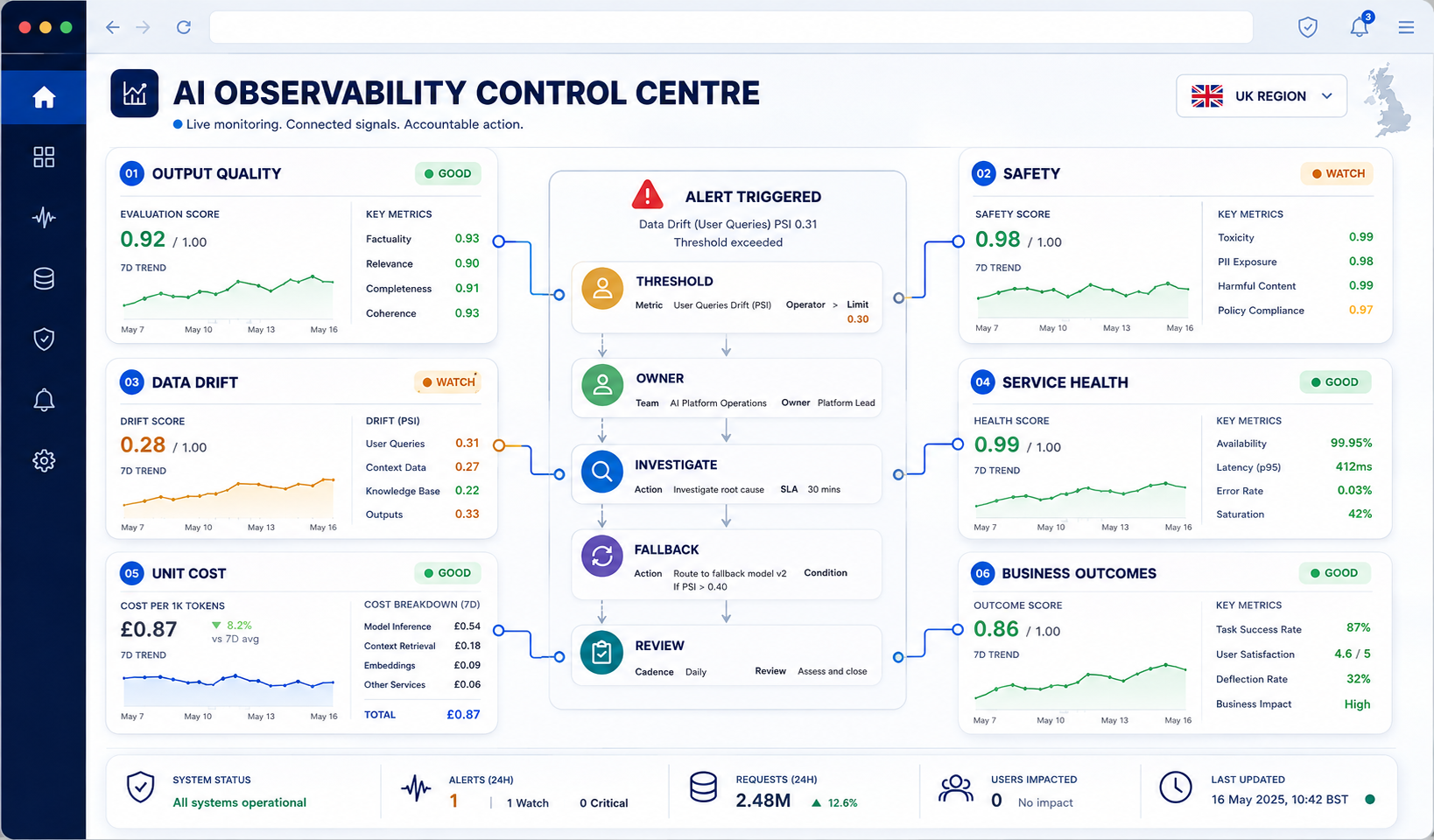
Output quality
Run task-specific evaluations on sampled live traffic. Track failures by use case, customer impact and version instead of relying on one generic accuracy score.
Safety and security
Detect policy breaches, prompt attacks, unusual access and unsafe tool actions. Join AI signals with identity, application and security telemetry.
Data behaviour
Watch input mix, missing fields, retrieval quality and sensitive-data exposure. Investigate material shifts before they silently change output quality.
Service health
Measure latency, availability, timeouts, retries and dependency failures. Keep a tested fallback when a model or external service is degraded.
Usage and cost
Attribute tokens, model calls, infrastructure and human review to customers and workflows. Alert on cost anomalies and declining unit economics.
Business outcomes
Connect technical signals to adoption, resolution, conversion, saved time or avoided loss. A healthy dashboard is meaningless if the workflow creates no value.
Your minimum monitoring specification
A four-step monitoring implementation
Start from decisions, not dashboards. Each signal needs an owner, threshold, investigation path and proportionate response.
Define decisions and owners
List the failures and changes that matter, who must know, who investigates and who can restrict or stop the system.
Instrument the workflow
Capture model, prompt, data, retrieval, application and business context with privacy-aware logs and stable version identifiers.
Build evaluations and thresholds
Combine deterministic checks, representative test sets, expert review and user feedback. Set warning and intervention thresholds for each use case.
Connect alerts to action
Route alerts into support and incident workflows, test fallback and rollback, and review measures whenever models, prompts, data or integrations change.
Basic telemetry versus AI observability
| Area | Basic telemetry | AI observability |
|---|---|---|
| Quality | Errors and response status | Use-case evaluations and reviewed failures |
| Context | Application and infrastructure logs | Model, prompt, retrieval and data versions |
| Security | Access and service events | Unsafe input, output and tool behaviour |
| Operations | Dashboard watched by engineers | Owned thresholds, escalation and fallback |
| Value | Request volume and spend | Workflow outcome and unit economics |
Make production AI measurable
Forge Cloudify helps UK teams instrument AI workflows, build evaluation pipelines and connect alerts to accountable operational decisions.
Frequently asked questions
What should an AI monitoring system track?
Track task-specific quality and safety alongside latency, availability, errors, usage and unit cost. Add data, security and business measures that fit the workflow, plus human overrides, complaints and fallback events.
How is AI monitoring different from application monitoring?
Application monitoring shows whether software is available and responsive. AI monitoring must also examine variable outputs, evaluation scores, input and data changes, policy failures and whether the system still delivers the intended business result.
Do we need to store every AI prompt and response?
Not automatically. Logging should be proportionate and designed around diagnosis, audit and privacy needs. Minimise personal or confidential data, control access and retention, and document why each field is captured.
Who should own AI monitoring?
A business owner should own the outcome and escalation decisions, supported by engineering, security, data protection and operational teams. Ownership must include authority to restrict, roll back or suspend the system.
Can Forge Cloudify implement AI observability?
Yes. Forge Cloudify can define measures, instrument AI workflows, build evaluation pipelines and dashboards, connect alerts to operations, and implement secure rollback and human-fallback routes.
Related services: AI Development, Software Development, API & System Integration, Cloud & DevOps, and All Forge Cloudify Services.