Software Discovery Workshop: What Should a UK Business Expect?
Replace early guesswork with evidence, explicit risks and a delivery route your leadership team can evaluate.
The direct answer
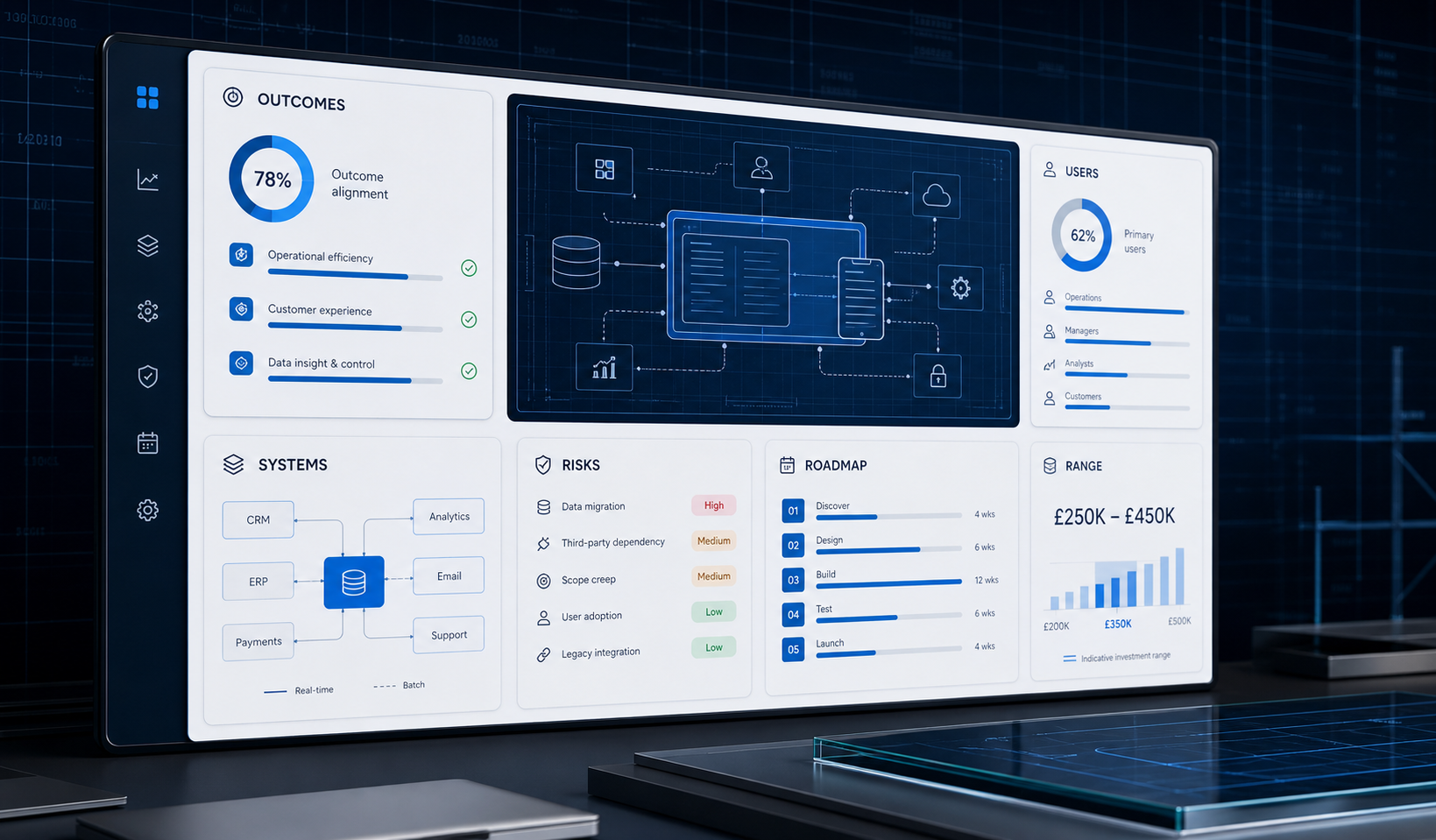
A software discovery workshop should turn an uncertain business problem into an evidence-backed decision before development starts. Expect aligned outcomes, prioritised user needs, mapped processes and systems, tested assumptions, delivery risks, a phased roadmap and an indicative investment range. The result should support a confident go, reshape or stop decision—not merely produce attractive workshop notes.
Discovery matters because early certainty is often artificial. The UK Government Service Manual describes discovery as learning about users and the problem space, including policy intent and constraints, before committing to build. Its guidance also warns that discovery is not the place to start building a service.
For a commercial buyer, that translates into a practical rule: fund enough investigation to make the next investment decision defensible. The Technology Code of Practice reinforces user needs, accessibility, security, open standards and whole-life cost. NCSC developer guidance likewise treats security as part of the development lifecycle, not a check added at launch.
Six outputs worth paying for
Business outcomes
Define the measurable operational or customer change, the decision owner and the constraints. A feature list without an outcome is not a discovery brief.
User evidence
Identify priority users, their context, current journeys and costly failure points. Separate observed evidence from stakeholder assumptions.
Process and systems
Map workflows, data, integrations, ownership and hand-offs. This reveals hidden dependencies before they become change requests during delivery.
Risk and security
Surface privacy, security, accessibility, compliance, migration and supplier risks early enough to influence the design and procurement route.
Phased roadmap
Order work by value, dependency and learning. Distinguish an MVP from later capability and name what must be validated before committing further.
Investment confidence
Provide ranges, assumptions and options rather than a suspiciously precise quote. Buyers should see what moves cost, timeline and delivery risk.
Your discovery acceptance checklist
A four-step discovery route
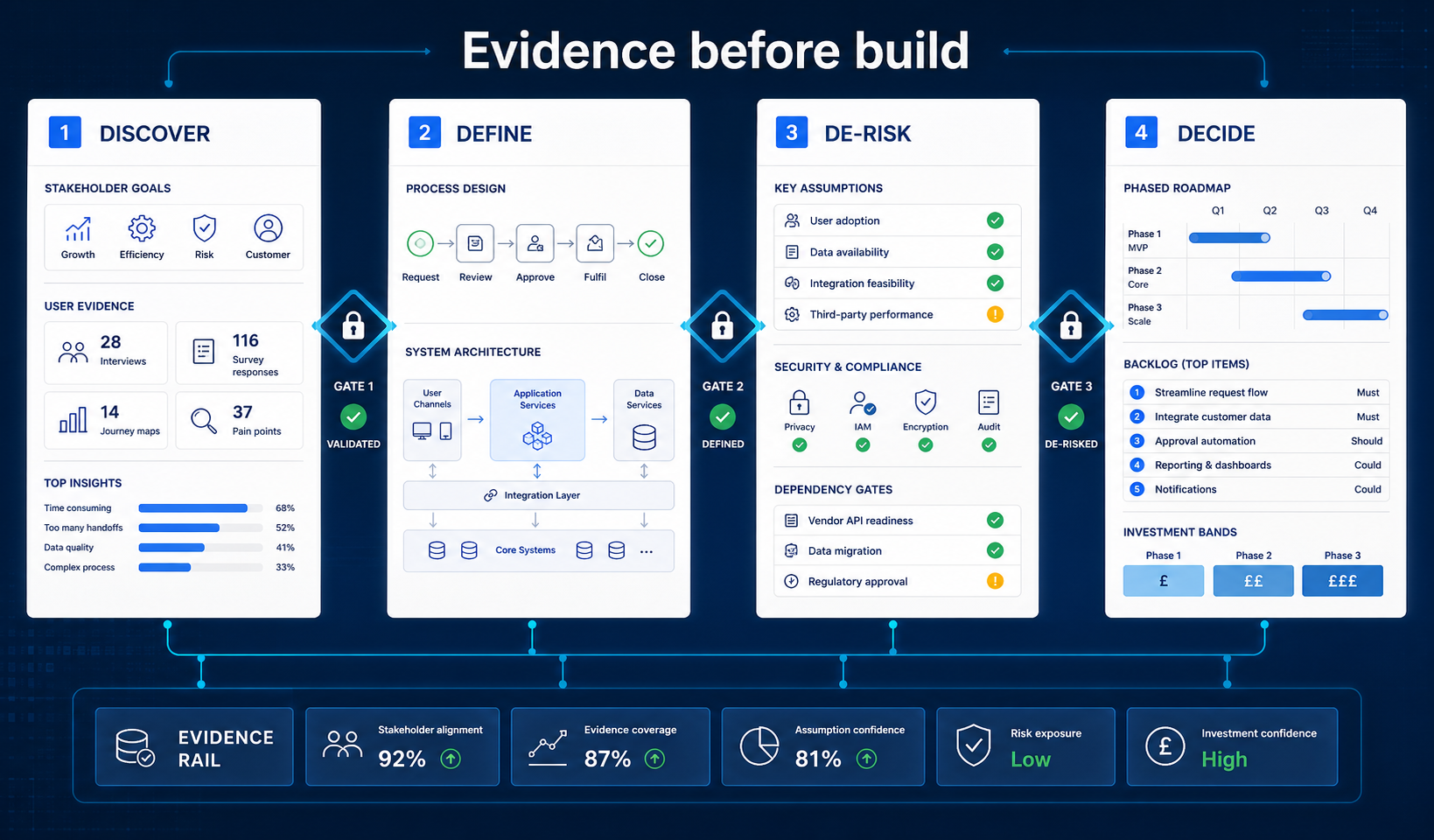
Treat discovery as a decision system. Each stage should reduce a named uncertainty and leave evidence that another capable team can understand.
Frame the decision
Agree the business outcome, users, constraints and decisions discovery must enable. Confirm stakeholders, evidence sources and artefact ownership.
Gather evidence
Interview users and operators, inspect workflows and systems, review available data, and document facts separately from assumptions.
Test feasibility
Explore solution options, architecture, integrations, data, security and delivery constraints. Prototype or spike the riskiest unknowns where evidence is weak.
Recommend the route
Present options, prioritised scope, roadmap, risks and investment range. Record the decision and the evidence required at the next funding gate.
Useful discovery versus a sales workshop
| Decision area | Evidence-led discovery | Weak sales-led workshop |
|---|---|---|
| Starting point | Business outcome, users and uncertain decisions | Preferred solution and feature wish list |
| Evidence | User, operational, data and technical findings | Stakeholder opinion presented as fact |
| Risk | Assumptions, dependencies and mitigations are visible | Risks appear later as exclusions or change requests |
| Estimate | Range with scope, assumptions and options | False precision designed to secure approval |
| Outcome | Go, reshape, validate further or stop | Build is treated as the only acceptable answer |
Make the build decision before buying the build
Forge Cloudify can facilitate a focused discovery, map your operating and technical landscape, test critical assumptions and turn the evidence into a phased software roadmap.
Frequently asked questions
What is a software discovery workshop?
It is a structured, evidence-led engagement before delivery. Business, user and technical stakeholders clarify the problem, outcomes, constraints, workflows, data, integrations and risks, then agree what should be validated or built first.
How long should software discovery take?
There is no universal duration. A focused workflow may need several workshops and targeted analysis; a regulated, data-heavy platform may require a longer discovery. Scope the work around unanswered decisions and evidence, not a ceremonial number of days.
What should we receive at the end?
Useful outputs normally include an outcome brief, user and process evidence, current and target system views, assumptions and risks, prioritised scope, architecture direction, delivery options, phased roadmap and indicative investment range with explicit caveats.
Does discovery guarantee a fixed development price?
No. Discovery reduces uncertainty but cannot eliminate it. It should explain which elements are understood, which require prototyping or technical spikes, and how estimates may change. A credible range is more useful than false precision.
Can we use the discovery outputs with another supplier?
Yes, if portability is agreed. Ask for accessible artefacts, decision records, assumptions and ownership terms. Avoid outputs that only make sense inside one supplier’s proprietary sales process.
Related services: Software Development, SaaS Development, Cloud & DevOps, and All Forge Cloudify Services.