The Founder's Guide to Turning an Idea Into a Digital Product
A strong digital product does not begin with a feature list. It begins with a founder making disciplined decisions about the problem, customer, MVP, technology, launch path, and feedback loop before money disappears into the wrong build.
Direct answer: how founders turn ideas into products
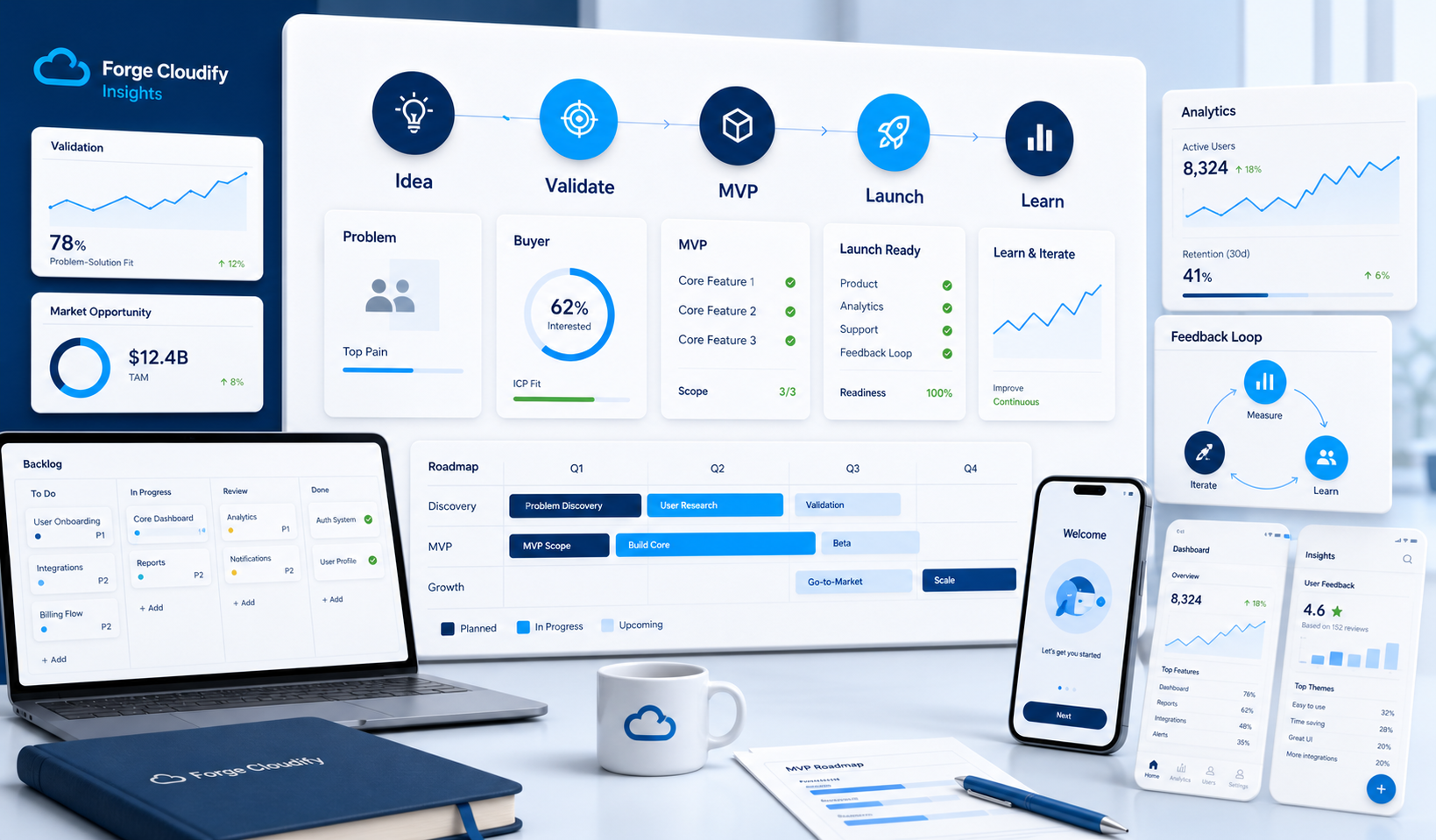
Digital product development works best when founders validate the problem before building, define a narrow MVP around one valuable user journey, plan the technical foundation, launch with analytics, and improve from real behaviour. The aim is not to build every feature quickly; it is to reduce risk while proving demand, usability, and commercial potential.
The idea is only the starting signal
Founders often describe a digital product as if the hard part is finding developers. In reality, development is only one part of the risk. The bigger question is whether the idea solves a painful enough problem for a specific enough group of people, in a way they will use, pay for, and recommend.
A product can fail even when the code is clean. It can fail because the target user is vague, the first release is too large, the budget is spread across low-value features, the onboarding is confusing, the pricing model is untested, or the founder waits too long before putting something real in front of customers.
Forge Cloudify’s approach is practical: turn the founder’s insight into a controlled product system. Validate first, scope sharply, build the right foundation, launch in a way that captures evidence, then improve the product from real usage rather than assumptions.
Six decisions to make before development
Who has the problem?
Define the buyer, user, industry, company size, role, and trigger event. A product for everyone usually becomes a product no one can immediately understand.
What proof exists?
Use interviews, competitor research, landing pages, demos, paid pilots, waiting lists, or manual service delivery to test whether demand is real before a full build.
What is the first outcome?
The MVP should deliver one meaningful result. For example: qualify a lead, process a document, book a service, track a workflow, generate a report, or complete a transaction.
Which features can wait?
Most early roadmaps are too full. Remove features that do not prove the main value proposition, reduce launch risk, or help users reach the core outcome.
What technical foundation is needed?
Choose architecture, data model, authentication, payments, integrations, AI components, hosting, security, and analytics based on the product’s next 12 months, not fantasy scale.
How will learning happen?
Plan what to measure before launch: activation, conversion, retention, support issues, failed journeys, feature usage, revenue signals, and customer objections.
Founder readiness checklist
Forge Cloudify’s product development path
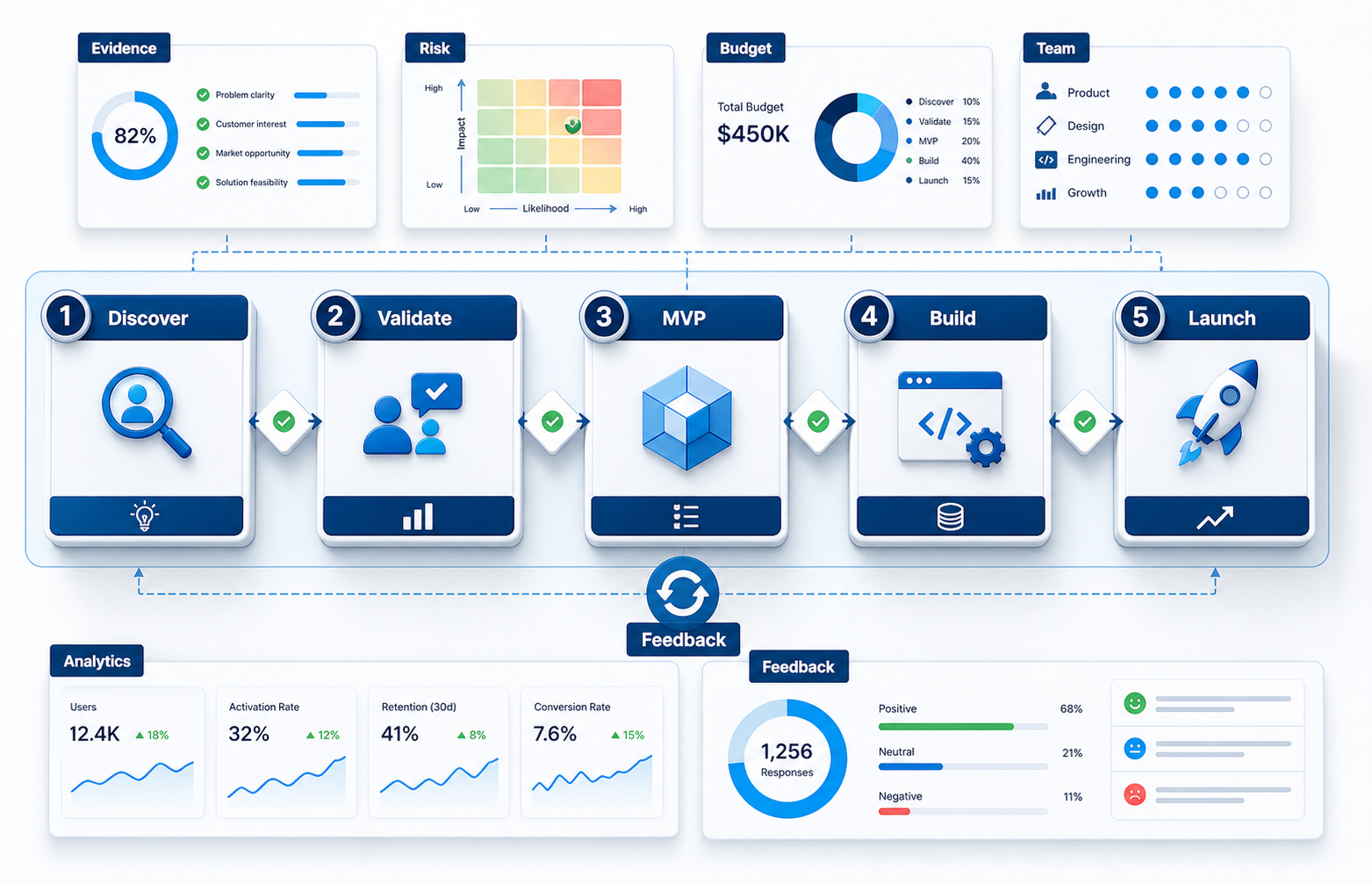
The safest product build is not slow. It is sequenced. Each phase should reduce a different kind of risk: market risk, user risk, technical risk, delivery risk, and commercial risk. That gives founders more control over spend and a better story for partners, investors, and early customers.
Discover and validate
We clarify the customer, pain point, competitive landscape, offer, MVP hypothesis, commercial model, and evidence needed before investing heavily in engineering.
Define the MVP roadmap
We map the user journey, core features, data objects, integrations, AI opportunities, analytics events, release priorities, and what should deliberately wait.
Design and build the product
We create the UX, technical architecture, backend, frontend, APIs, database, authentication, payments or workflows, admin tools, testing, and deployment pipeline.
Launch, measure, and iterate
We support launch readiness, analytics, feedback loops, bug fixing, performance, security checks, user onboarding, and the next product decisions after real-world usage.
Prototype, MVP, or full platform?
| Build option | Best fit | Founder risk if misused |
|---|---|---|
| Prototype | Testing the concept, showing screens to users, aligning investors, and validating the user journey before production engineering. | It can create false confidence if users praise the idea but do not commit time, data, payment, or a meaningful next step. |
| MVP | Launching the smallest production-ready version that solves one important problem for early users and captures evidence. | It fails when founders treat MVP as a cheap full product instead of a narrow learning and value-delivery release. |
| Full platform | Scaling a validated product with richer workflows, integrations, roles, compliance, reporting, automation, and growth infrastructure. | Building the full platform too early can lock budget into assumptions that users have not confirmed yet. |
Common founder mistakes
The most expensive mistake is confusing confidence with validation. A founder may understand the industry deeply and still need evidence that the proposed product, price, positioning, and workflow match how customers actually behave. Strong discovery does not slow the product down. It protects the build from avoidable waste.
Another common mistake is treating technology as the differentiator too early. AI, automation, dashboards, mobile apps, and integrations can all create leverage, but only when they support a real use case. The product strategy should decide the technology, not the other way around.
What founders should budget for
A realistic digital product budget includes more than development hours. Discovery, UX design, technical planning, frontend, backend, database design, testing, hosting, security, analytics, integrations, content, onboarding, and post-launch improvements all matter. Cutting the wrong part often creates more cost later.
For early-stage founders, the practical question is not "What is the cheapest possible build?" It is "What is the smallest build that can prove the product deserves the next investment?" That framing creates better MVPs, clearer investor conversations, and a more honest roadmap.
Ready to turn your idea into a buildable product plan?
Forge Cloudify can help validate the product concept, define the MVP, design the roadmap, build the software, add AI or integrations where useful, and support the first launch with real feedback loops.
Frequently asked questions
How do I turn an idea into a digital product?
Start by proving the problem, identifying the buyer, validating willingness to pay, defining the smallest useful MVP, choosing a practical technical approach, building in focused phases, launching to real users, and improving from feedback and analytics.
Should a founder build an MVP before raising investment?
Usually yes. An MVP, prototype, or validated product demo can give investors clearer evidence than a pitch alone. The right version depends on budget, technical complexity, and what proof the market needs before it will believe the product.
What should be included in a digital product MVP?
A good MVP includes the smallest set of features needed to deliver one clear outcome for one target user group. It should include the core workflow, basic onboarding, enough security, analytics, support paths, and a feedback loop.
How long does digital product development take?
Simple MVPs may take weeks, while more complex SaaS platforms, marketplaces, integrations, or regulated products can take several months. Discovery, UX, technical architecture, integrations, testing, and launch readiness often decide the real timeline.
Can Forge Cloudify help founders build digital products?
Yes. Forge Cloudify helps founders shape ideas, validate MVP scope, design product roadmaps, build SaaS platforms and web apps, connect APIs, add AI features, and prepare launch-ready digital products for UK and global markets.
Related services: Software Development, AI Development, Website Development, Cloud & DevOps, Project Estimate, and All Forge Cloudify Services.