
How DevOps Reduces Downtime, Bugs, and Release Stress
Releases should not feel like a late-night gamble. Good DevOps gives a business a controlled way to ship, monitor, recover, and improve without turning every update into a production incident.
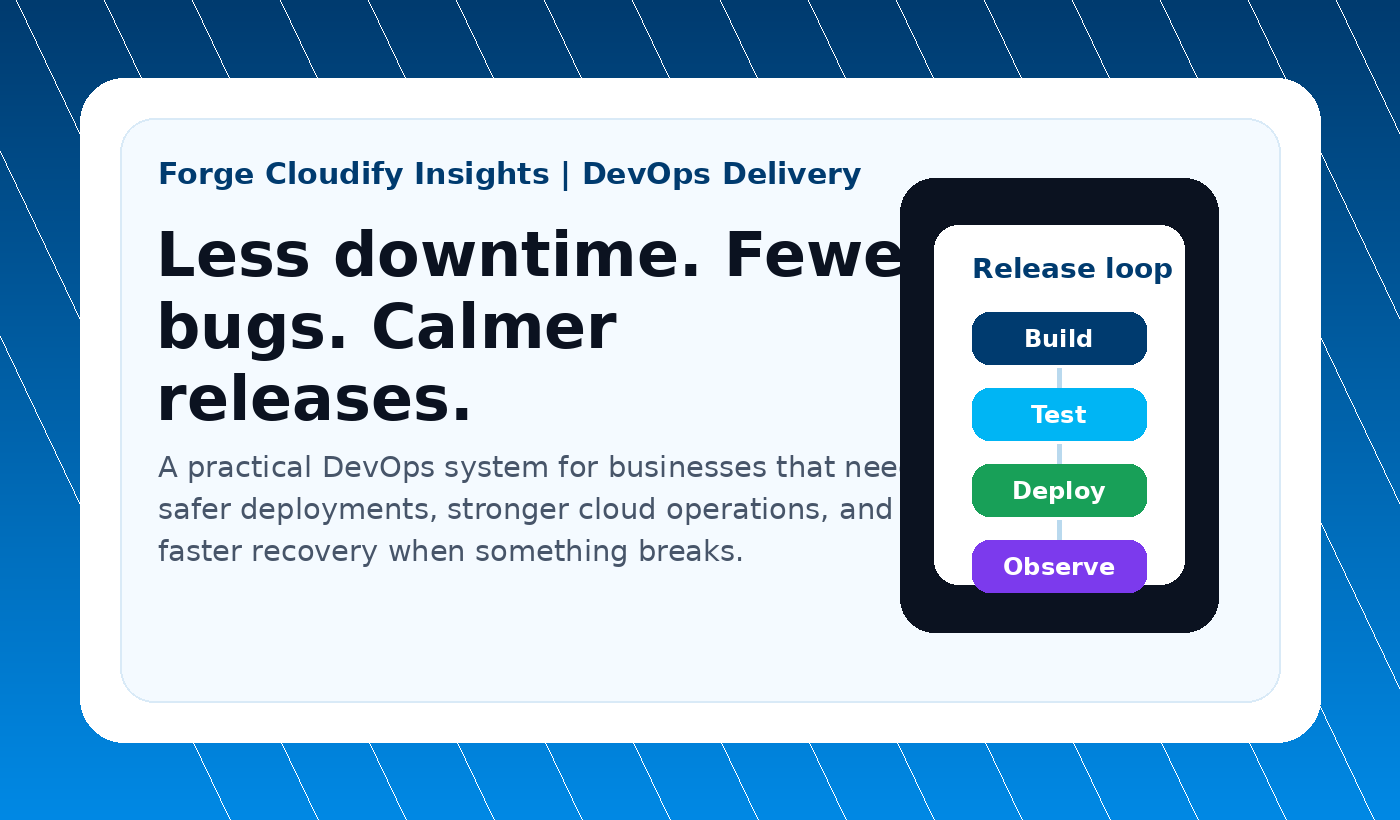
Direct answer: how DevOps lowers release risk
DevOps reduces downtime, bugs, and release stress by turning software delivery into a repeatable system: automated builds, tests, deployments, infrastructure, monitoring, rollback plans, and incident feedback. Instead of relying on risky manual releases, teams ship smaller changes, catch problems earlier, recover faster, and make production behaviour visible.
DevOps is not just tools. It is operational discipline.
A business often notices the need for DevOps after the same symptoms keep returning: releases take too long, fixes create new bugs, deployments need one person who knows the secrets, servers drift away from documentation, and nobody sees a problem until customers complain.
Forge Cloudify approaches DevOps consulting services as a practical reliability upgrade. The aim is not to add process for its own sake. The aim is to reduce avoidable downtime, make releases boring, and give the team confidence that the product can keep improving without breaking operations.
Six ways DevOps reduces downtime, bugs, and stress
Smaller releases
Smaller, frequent changes are easier to review, test, deploy, and reverse. They reduce the blast radius compared with large releases that combine weeks of unknown risk.
Automated pipelines
CI/CD pipelines remove fragile manual steps. Code can be built, tested, scanned, packaged, and deployed with the same controlled workflow each time.
Better test gates
Unit tests, integration tests, smoke tests, and release checks catch many issues before customers see them. The goal is fast feedback, not endless ceremony.
Infrastructure as code
Cloud environments become reproducible. Teams can review infrastructure changes, reduce configuration drift, and rebuild with more confidence after failure.
Observability
Monitoring, logging, tracing, alerting, and dashboards help teams understand production behaviour quickly instead of guessing during an outage.
Recovery planning
Backups, rollback strategy, runbooks, incident ownership, and post-incident learning make failures less chaotic and make the next release safer.
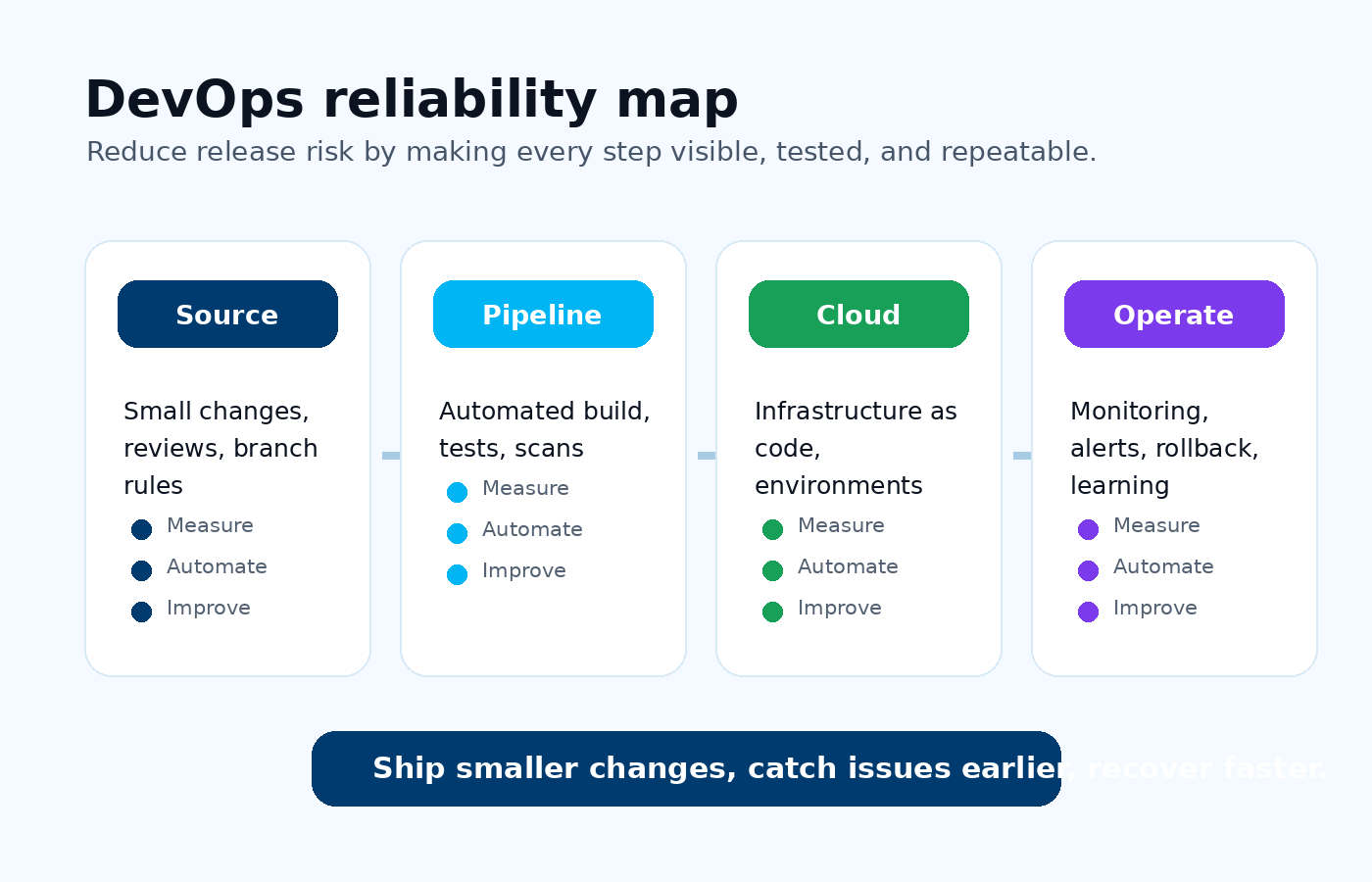
What a healthy DevOps foundation includes
Forge Cloudify’s DevOps improvement process
The best DevOps work starts with the current delivery pain, then improves the highest-risk parts first. A startup, SaaS platform, ecommerce operation, and internal business app will not need the same rollout.
Assess the release path
We review repositories, environments, hosting, deployment steps, security gaps, monitoring, failure history, and the manual work around each release.
Design the delivery system
We define the target pipeline, cloud structure, access model, test gates, environment strategy, backup requirements, and recovery approach.
Automate and harden
We implement practical CI/CD, infrastructure automation, monitoring, alerts, secrets handling, release checks, and rollback support without overengineering.
Measure and improve
We track delivery and reliability signals, review incidents, remove bottlenecks, and keep tuning the system as the product and team grow.
Before and after DevOps consulting
| Area | Before | After |
|---|---|---|
| Deployments | Manual commands, unclear steps, late-night release windows, and fear of touching production. | Repeatable pipelines, approval gates where needed, safer rollouts, and clearer release history. |
| Bugs | Issues found after launch because testing is inconsistent or environments do not match. | Earlier feedback through automated tests, staging checks, smoke tests, and monitored releases. |
| Downtime | Slow diagnosis, missing alerts, uncertain rollback, and customer reports becoming the first signal. | Health checks, logs, dashboards, alerts, backup routines, and rehearsed recovery paths. |
| Team stress | Knowledge trapped with one person and every incident becoming an improvised rescue effort. | Documented runbooks, shared ownership, visible systems, and less drama around routine changes. |
What to measure first
Research from DORA and cloud delivery teams keeps pointing to the same idea: speed and stability should be measured together. Deployment frequency and lead time show how quickly value moves to users. Change failure rate, recovery time, and rework show whether that speed is creating operational damage.
For a growing UK business, the first target is usually not elite engineering performance. It is control: know how often releases happen, how long they take, how often they fail, how quickly the team recovers, and which manual steps keep causing avoidable risk.
Want calmer, safer software releases?
Forge Cloudify can audit your current release process, build CI/CD pipelines, improve cloud infrastructure, add monitoring, and create a DevOps roadmap that fits the stage of your product and team.
Frequently asked questions
What do DevOps consulting services include?
DevOps consulting services usually include delivery assessment, CI/CD pipeline setup, cloud infrastructure design, automation, monitoring, deployment strategy, security checks, incident readiness, and practical coaching for development and operations teams.
How does DevOps reduce downtime?
DevOps reduces downtime by improving deployment quality, monitoring production health, using tested rollback or recovery plans, automating infrastructure, and giving teams faster feedback when a release or system component starts failing.
Does DevOps only matter for large companies?
No. Small and growing businesses benefit because manual releases, fragile hosting, missing backups, and unclear incident ownership become painful long before a company feels enterprise-sized.
Is DevOps the same as cloud hosting?
No. Cloud hosting is where systems run. DevOps is the delivery and operations discipline around building, testing, deploying, observing, securing, and improving those systems.
Can Forge Cloudify improve an existing release process?
Yes. Forge Cloudify can review the current workflow, identify release risks, build cleaner pipelines, improve cloud infrastructure, add monitoring, and create a practical path from stressful releases to controlled delivery.
Related services: Cloud & DevOps, Software Development, ERP Development, Project Estimate, and All Forge Cloudify Services.