Why Most Websites Do Not Convert and How to Fix Them
Conversion is not magic. It is the result of clear positioning, low-friction UX, fast pages, useful proof, and a follow-up system that does not waste good visitors.
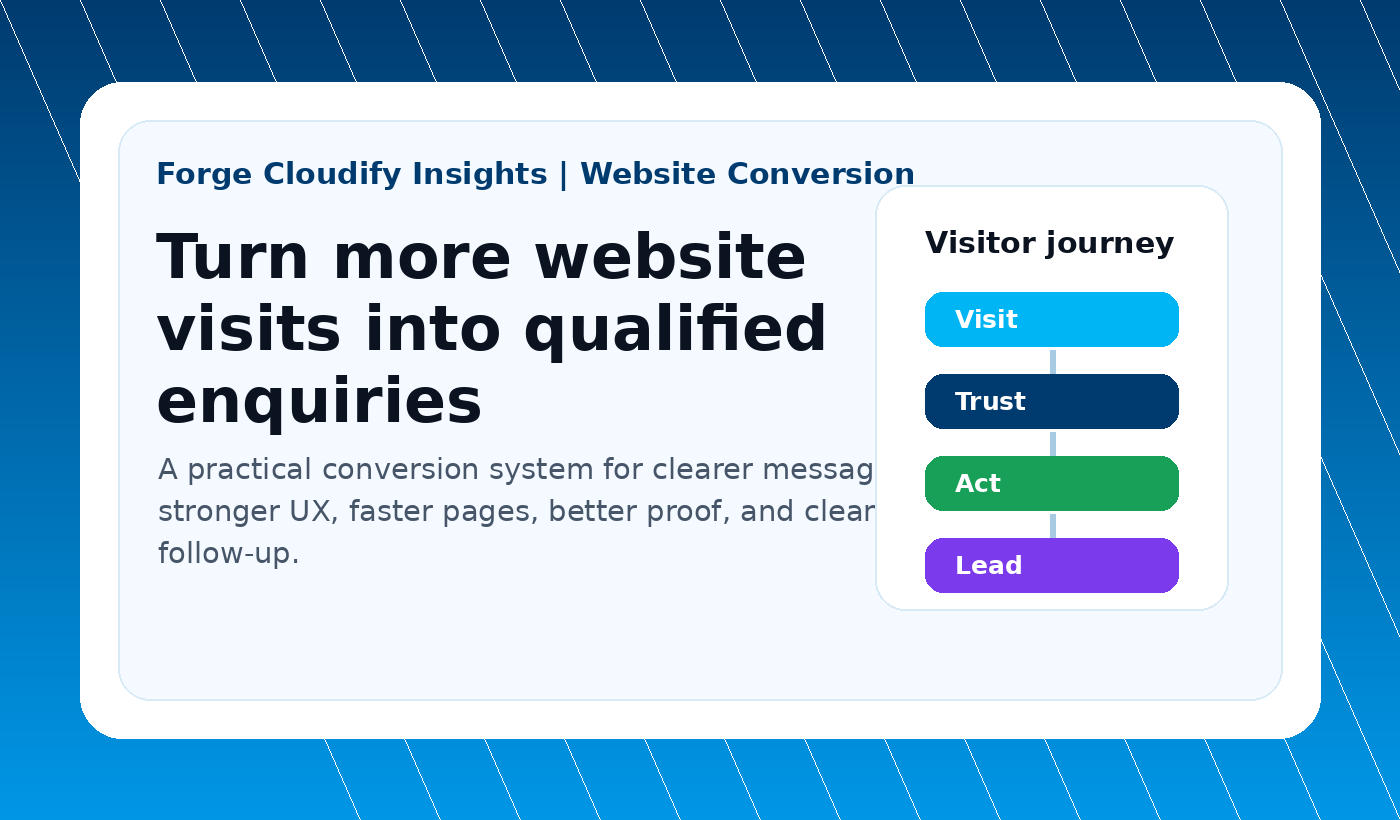
Direct answer: why do most websites not convert?
Most websites do not convert because visitors cannot quickly understand the offer, trust the business, see the next step, or complete the action without friction. Fix conversion by tightening the message, improving speed and mobile UX, simplifying journeys, strengthening proof, and measuring each step from visit to enquiry or sale.
Traffic is not the same as demand
Many businesses treat low website conversions as a traffic problem. Sometimes it is. More often, the site is receiving visitors but failing to make a strong case. The page sounds broad, the offer is vague, the proof is thin, or the visitor has to work too hard to understand what happens next.
Forge Cloudify looks at conversion as a system. The website has to attract the right intent, explain the value, answer risk questions, perform well on mobile, collect the enquiry cleanly, and pass it into a follow-up process. If one link is weak, the whole journey leaks.
Six reasons websites fail to convert
Unclear offer
If the hero section could belong to any company, it will not persuade the right buyer. Strong pages say what the business does, who it helps, and what outcome the visitor can expect.
Weak journey
Visitors should not have to hunt for pricing cues, service detail, examples, FAQs, or the next step. Navigation and page structure should guide them from interest to action.
Slow experience
Google’s Core Web Vitals focus on loading, interactivity, and layout stability because those qualities affect real user experience. A page that feels slow quietly reduces trust and momentum.
Missing proof
Claims need evidence. Case studies, service process, screenshots, testimonials, metrics, security cues, and sector examples help visitors believe the business can deliver.
High-friction forms
Long forms, unclear labels, unnecessary fields, broken validation, and no expectation-setting can stop motivated visitors. Ask only what is needed to start the conversation well.
Poor tracking
If analytics only show page views, the team cannot see where conversion breaks. Events, form tracking, calls, CRM source data, and funnel steps make improvement measurable.
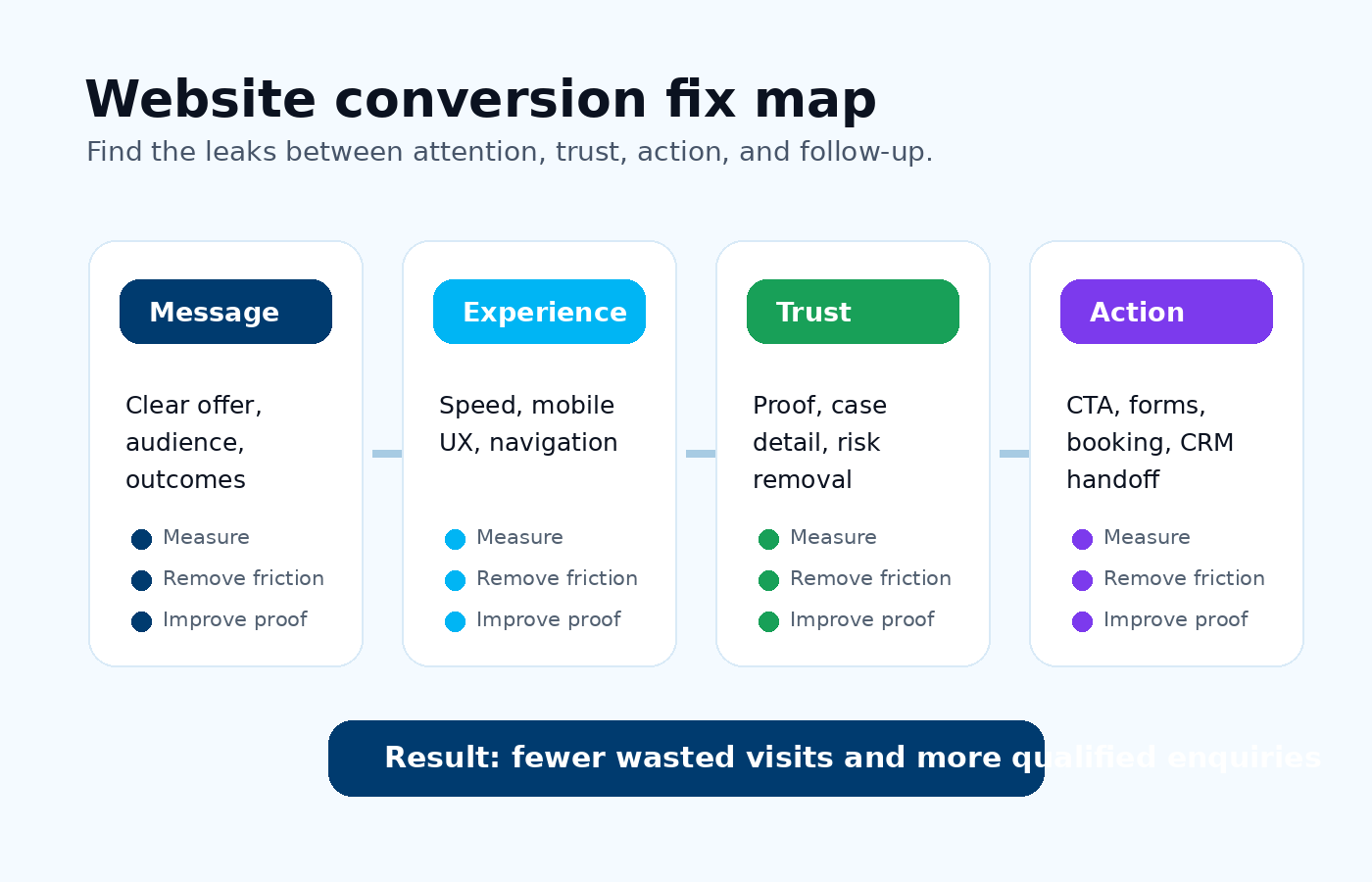
Website conversion optimization checklist
Forge Cloudify’s process for fixing conversions
A better-converting website usually comes from practical diagnosis, not random redesign. We start by finding the real leak, then improve the page, the technical experience, and the operational handoff behind the enquiry.
Audit the journey
We review analytics, search intent, landing pages, mobile UX, forms, calls to action, speed, trust signals, and how enquiries enter the sales process.
Sharpen the message
We clarify the offer, audience, outcomes, objections, service detail, and proof so visitors can quickly decide whether the business fits their need.
Remove technical friction
We improve performance, responsive layout, accessibility basics, form reliability, tracking events, CRM handoff, and automation where manual follow-up is slowing sales.
Measure and iterate
We compare enquiry quality, form starts, completions, CTA clicks, page engagement, source data, and sales feedback so improvements are tied to real outcomes.
Common conversion problems and fixes
| Problem | What visitors experience | Better fix |
|---|---|---|
| Generic homepage | The visitor sees broad claims but no clear reason to trust or contact the business. | Lead with a specific offer, buyer type, outcome, proof, and one primary CTA. |
| Service page with thin detail | The visitor cannot judge fit, process, cost drivers, risks, or what delivery includes. | Add practical detail, examples, FAQs, process steps, and links to relevant services. |
| Slow or unstable page | The page feels heavy, shifts while loading, or responds slowly on mobile. | Optimize assets, scripts, hosting, layout stability, caching, and Core Web Vitals. |
| Form friction | The visitor hesitates because the form asks too much or gives no expectation of response. | Reduce fields, improve labels, confirm next steps, track submissions, and connect CRM alerts. |
What to fix before spending more on ads
Paid traffic can expose a conversion problem faster, but it does not solve one. Before increasing ad spend, check whether your page matches the promise in the advert, whether the first screen explains the offer, whether mobile users can act easily, and whether the follow-up process responds quickly.
The highest-value fixes are often simple but disciplined: clearer headings, stronger service detail, better proof, faster loading, fewer form fields, visible CTAs, and a CRM workflow that prevents leads from sitting unanswered.
Want your website to create better enquiries?
Forge Cloudify can audit your website, fix weak conversion journeys, rebuild high-intent pages, improve performance, connect lead forms to your CRM, and create a clearer path from visitor to customer.
Frequently asked questions
What is website conversion optimization?
Website conversion optimization is the process of improving a site so more visitors take the intended action, such as booking a call, submitting an enquiry, buying a product, downloading a resource, or starting a trial.
Why is my website getting traffic but no leads?
Traffic without leads usually means the page is attracting the wrong intent, the offer is unclear, the call to action is weak, the form creates friction, or the page does not build enough trust before asking visitors to act.
What should a conversion audit include?
A useful conversion audit should review analytics, traffic intent, messaging, page speed, mobile experience, navigation, forms, CTAs, trust signals, content depth, tracking, and the full journey from landing page to enquiry or checkout.
How quickly can conversion fixes show results?
Some fixes, such as clearer CTAs, shorter forms, better proof, and improved page speed, can influence results quickly. Bigger gains often need testing, journey redesign, better tracking, and enough traffic to compare performance fairly.
Can Forge Cloudify help improve website conversions?
Yes. Forge Cloudify can audit your website, improve UX and performance, rebuild weak landing pages, connect forms and CRM workflows, add automation, and create tracking that shows where leads are won or lost.
Related services: Software Development, AI Development, Cloud & DevOps, Project Estimate, and Our Services.