
The Real Cost of Building a Web App in the UK
A practical guide to web app development cost in the UK: what changes the budget, what should be included, and how to scope a build without paying for avoidable rework.
Direct answer: what drives web app development cost in the UK?
Web app development cost in the UK usually depends on scope, user roles, integrations, design complexity, data security, testing, and post-launch support. A focused internal tool may cost far less than a SaaS platform, but the safest budget starts with a clear workflow, phased release plan, and known technical risks.
Why web app estimates vary so widely
Two businesses can ask for a “web app” and mean completely different things. One may need a simple staff portal with login, forms, and reporting. Another may need subscriptions, customer accounts, payment flows, API integrations, audit logs, admin dashboards, analytics, security reviews, and cloud infrastructure. The phrase is small; the delivery work underneath can be large.
A useful estimate separates the business outcome from the feature wish list. The budget should explain what is included, what is deliberately postponed, where uncertainty remains, and which decisions could make the project larger or smaller.
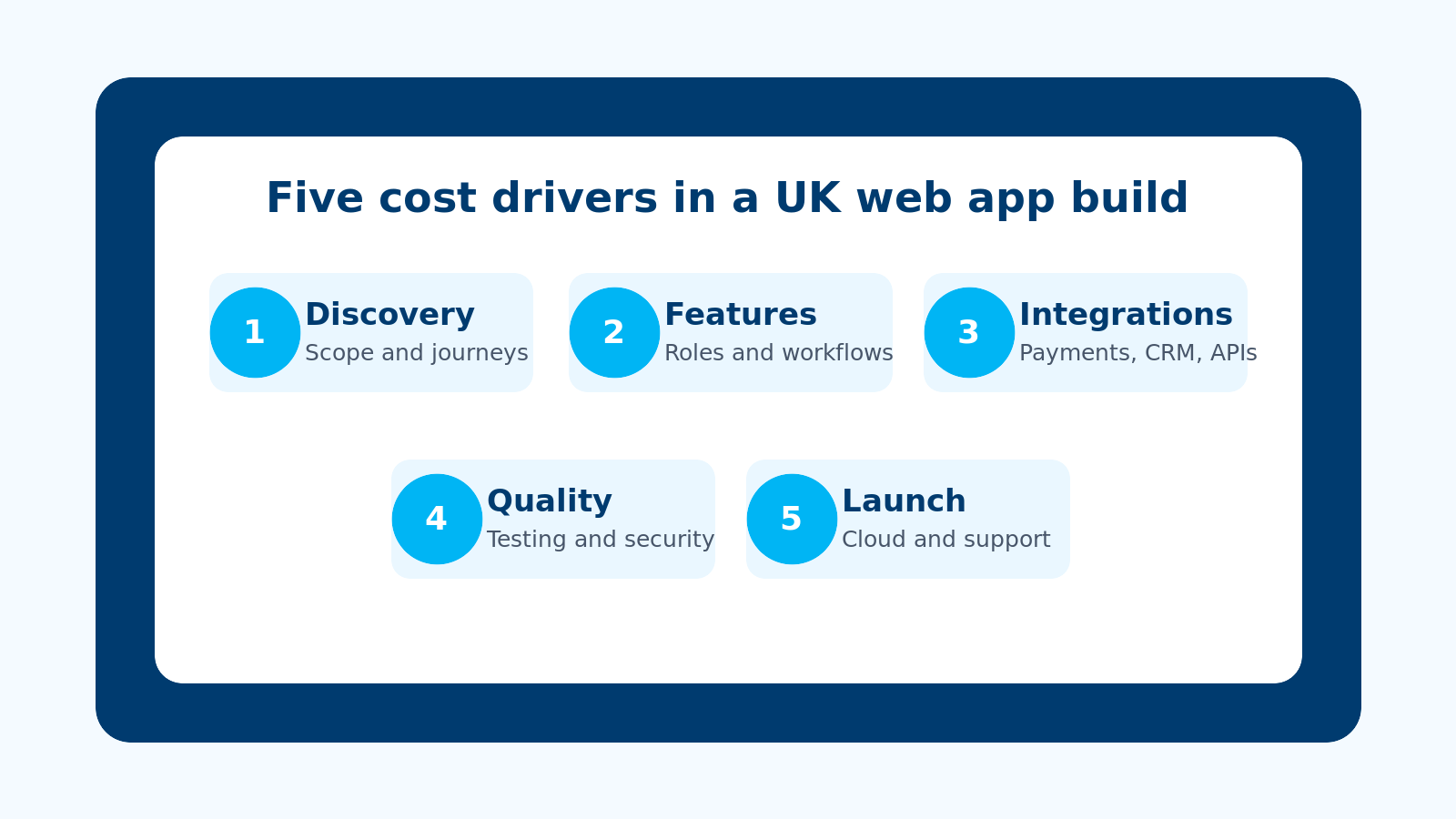
Six cost drivers to understand before requesting quotes
Discovery and scope
Clear user journeys reduce waste. If the brief does not define who uses the app, what job they complete, and which edge cases matter, the project will pay for discovery later through delays and revisions.
User roles and permissions
A public calculator is cheaper than a platform with customers, staff, managers, finance users, support agents, and admin controls. Every role adds rules, screens, testing, and risk.
Workflow complexity
The more steps, approvals, notifications, documents, statuses, and exception paths the app needs, the more design and backend logic it requires. Simple screens can hide complex business rules.
Integrations and data
Payments, CRM, ERP, email, WhatsApp, accounting, analytics, maps, or third-party APIs can create major value, but each integration needs authentication, error handling, logging, and fallback decisions.
Design and usability
Good UX is not decoration. It decides whether staff and customers can actually use the product. Dashboards, forms, onboarding, responsive views, and accessibility all affect the final build effort.
Security and launch quality
Authentication, data protection, backups, monitoring, deployment pipelines, performance testing, and QA can look invisible in a quote, but they are what keep the app reliable after launch.
What a realistic web app budget should include
How Forge Cloudify scopes a web app without wasting budget
The best budget is not the cheapest number on paper. It is the clearest route to a useful product. We prefer to shape web app projects around a practical first release, then extend from real evidence rather than assumptions.
Define the business workflow
We map the users, current process, pain points, required data, success metrics, and the first workflow that must work end to end. This prevents vague requirements from turning into expensive changes.
Separate must-have from later
We identify the version-one features that prove value and the features that can safely wait. A disciplined “not included yet” list is one of the strongest cost-control tools.
Design the technical foundation
We choose the architecture, database model, integrations, hosting, security controls, and deployment approach that match the risk level of the product without over-engineering the first release.
Launch, measure, and improve
After deployment, the budget should support real-world learning: bug fixes, user feedback, analytics review, performance improvements, and the next roadmap decision.
Cheap build vs well-scoped build
| Decision area | Cheap quote risk | Well-scoped web app build |
|---|---|---|
| Scope | Assumes the brief is complete and leaves hidden workflow gaps for later. | Defines users, journeys, edge cases, exclusions, and release priorities before build. |
| Quality | May skip testing, documentation, backups, monitoring, or security work to look lower. | Includes the engineering work needed for a stable business application. |
| Change control | Every unclear detail becomes a surprise cost or schedule argument. | Uses a roadmap and decision process so changes are deliberate, priced, and prioritised. |
| Long-term value | Can become expensive when the app needs scaling, integrations, or cleanup soon after launch. | Balances speed with a foundation that can support the next release. |
Practical ways to control cost
Start with one valuable workflow. Reduce custom settings until the first users prove they are needed. Avoid building every dashboard before the app has real data. Use existing services for payments, email, authentication, and infrastructure when they fit. Most importantly, keep decisions tied to business evidence: time saved, revenue enabled, manual work removed, errors reduced, or customers served better.
Planning a web app budget for a real business outcome?
Forge Cloudify helps businesses plan, design, build, deploy, and improve custom web apps with clear scope, practical architecture, and a roadmap that protects budget from avoidable rework.
Frequently asked questions
How much does a web app cost in the UK?
The cost depends on scope, integrations, design, security, and support needs. A focused internal tool can be relatively lean, while a SaaS platform or customer portal with payments, roles, dashboards, and integrations needs a larger budget and a more careful release plan.
Why do web app development quotes vary so much?
Quotes vary because teams may be pricing different levels of discovery, design, engineering quality, testing, security, infrastructure, project management, and post-launch support. A cheaper quote may exclude important delivery work that appears later as delays or rework.
What should be included in a web app development budget?
A sensible budget should include discovery, UX planning, interface design, frontend and backend development, database design, integrations, testing, cloud deployment, security basics, analytics, documentation, and support after launch.
Can I reduce the cost by starting with an MVP?
Yes. An MVP can reduce initial cost if it is scoped around one valuable workflow and clear success criteria. It does not mean building something fragile; it means delaying non-essential features until the business has evidence.
Does Forge Cloudify build custom web apps for UK businesses?
Yes. Forge Cloudify helps UK and international businesses plan, design, develop, deploy, and improve custom web apps, SaaS platforms, dashboards, portals, integrations, and cloud-ready software systems.
Related services: Software Development, Cloud & DevOps, AI Development, All Forge Cloudify Services, and Project Estimate.