
How to Plan a SaaS MVP That Investors and Customers Understand
A practical SaaS MVP plan turns a product idea into something customers can use, investors can judge, and a development team can build without wasting months on the wrong scope.

Direct answer: what should a SaaS MVP plan prove?
A SaaS MVP should prove one valuable customer workflow, not display every future feature. Define the target user, the painful problem, the smallest paid or usable outcome, and the evidence investors need: demand, retention signals, unit economics, delivery risk, and a credible roadmap from first release to scalable product.
A clear SaaS MVP plan has six parts
Customer and problem
Name the exact user, their current workaround, the cost of the problem, and the moment they would naturally use the product. Investors and customers both lose confidence when the audience is described as “everyone”.
One valuable journey
Map the smallest end-to-end journey that creates value: sign up, complete the core task, see a result, and understand the next step. Leave admin luxuries, edge-case settings, and nice-to-have integrations for later.
Evidence milestones
Define what success will look like before build starts. Useful MVP milestones include discovery interviews, waitlist conversion, trial activation, repeated usage, pilot feedback, revenue intent, or signed letters of intent.
Commercial assumptions
Show how the product may make money. For UK B2B SaaS, that often means pricing bands, expected onboarding effort, support cost, sales cycle length, and the first narrow segment where payback could make sense.
Technical guardrails
Choose architecture that is simple enough for speed but not disposable. Authentication, data model, audit trail, payments, analytics, hosting, security basics, and integration boundaries should be decided deliberately.
Launch and learning loop
An MVP is not finished at deployment. Plan who will test it, what feedback will be collected, which metrics will be reviewed weekly, and what decision will follow: iterate, narrow, expand, or stop.
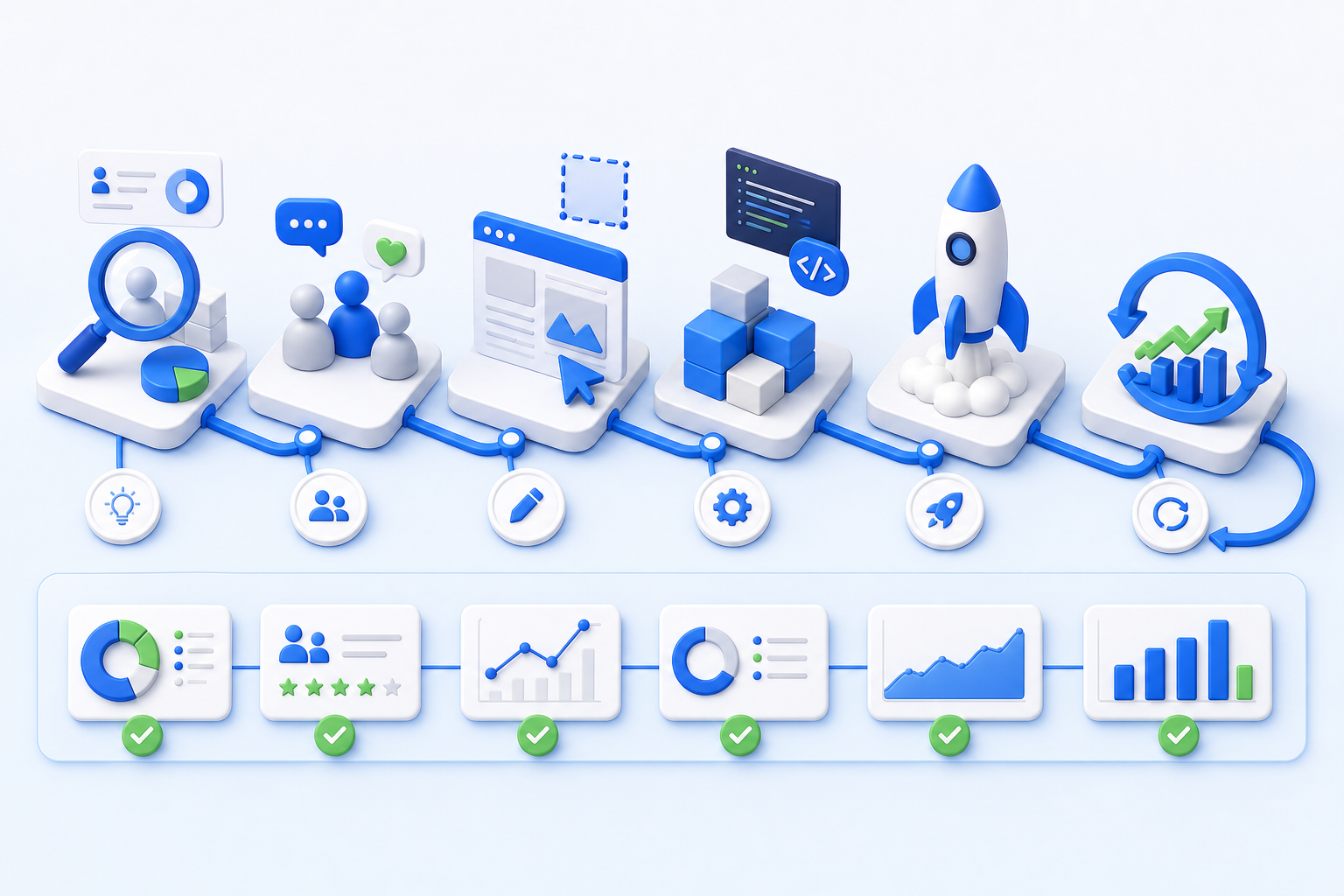
Before development starts, confirm these decisions
How Forge Cloudify would shape the MVP roadmap
The strongest MVP plans are easy to explain because they connect product scope to business proof. Our preferred process is intentionally practical: discover the customer truth, design the smallest useful workflow, build the right foundation, then measure what the market actually does.
Frame the investor and customer story
Write the product in plain language: who it helps, what painful job it handles, why now, and why the first niche is worth pursuing. This becomes the backbone for demos, landing pages, investor updates, and development priorities.
Turn the story into release scope
Separate must-have workflow steps from impressive but unnecessary features. For example, a compliance SaaS MVP may need role-based access and evidence capture, while advanced dashboards and broad integrations can wait.
Build the proof system into the product
Add analytics, onboarding prompts, feedback capture, usage events, and simple reporting from the start. Without this, the MVP may launch but still fail to answer the investor question: is the market pulling this forward?
Review, decide, and extend carefully
After early usage, compare evidence against the original assumptions. A good MVP plan makes decisions easier: improve activation, adjust pricing, deepen one workflow, add an integration, or pause before more budget is spent.
Feature-heavy MVP vs evidence-led MVP
| Decision area | Feature-heavy MVP | Evidence-led SaaS MVP |
|---|---|---|
| Scope | Multiple roles, broad settings, complex dashboards, and future roadmap ideas squeezed into version one. | One core workflow, clear exclusions, and just enough infrastructure to test real behaviour. |
| Investor narrative | “We built many things” but weak proof that customers care, return, or pay. | “We tested a sharp problem” with visible demand, product usage, feedback, and next-step economics. |
What customers need to understand
Customers do not buy an MVP because it is technically clever. They care whether it removes a painful task, saves time, lowers risk, or gives them clearer control. Keep onboarding simple, explain the product outcome in one sentence, and design the first session so a user reaches value quickly.
What investors need to understand
Investors need to see why this narrow product can become a larger company. Connect the MVP to market size, pricing logic, retention potential, defensibility, and the next experiments. A small release is acceptable when the learning path is commercially serious.
Planning a SaaS MVP for a real market?
Forge Cloudify helps founders and growing companies turn SaaS ideas into focused MVP roadmaps, product prototypes, cloud-ready builds, and measurable launch plans that customers and investors can understand.
Frequently asked questions
What is the best way to plan a SaaS MVP?
Start with one target customer, one painful workflow, and one measurable outcome. Then define the smallest release that proves demand, usage, and willingness to pay before adding broader product features.
How much should be included in a SaaS MVP?
Include only the features needed for a customer to complete the core job and for the team to measure whether the product is useful. Authentication, basic security, analytics, and a stable data model usually matter more than visual extras.
What do investors want to see from a SaaS MVP?
Investors usually want clarity: a specific market, a painful problem, evidence of demand, early usage or revenue signals, sensible economics, and a roadmap that shows how the MVP can become a scalable product.
Can Forge Cloudify help with SaaS MVP development in the UK?
Yes. Forge Cloudify can help with MVP strategy, UX planning, custom software development, AI features, cloud architecture, integrations, launch support, and iteration after early customer feedback.
Related services: AI Development, Software Development, Cloud & DevOps, and All Forge Cloudify Services.