
Mobile App Development for Businesses: Native, Hybrid, or Web App?
Choosing the app type is not a technology fashion decision. It is a business decision about users, features, cost, speed, maintenance, and how the product will grow after launch.
Direct answer: native, hybrid, or web app?
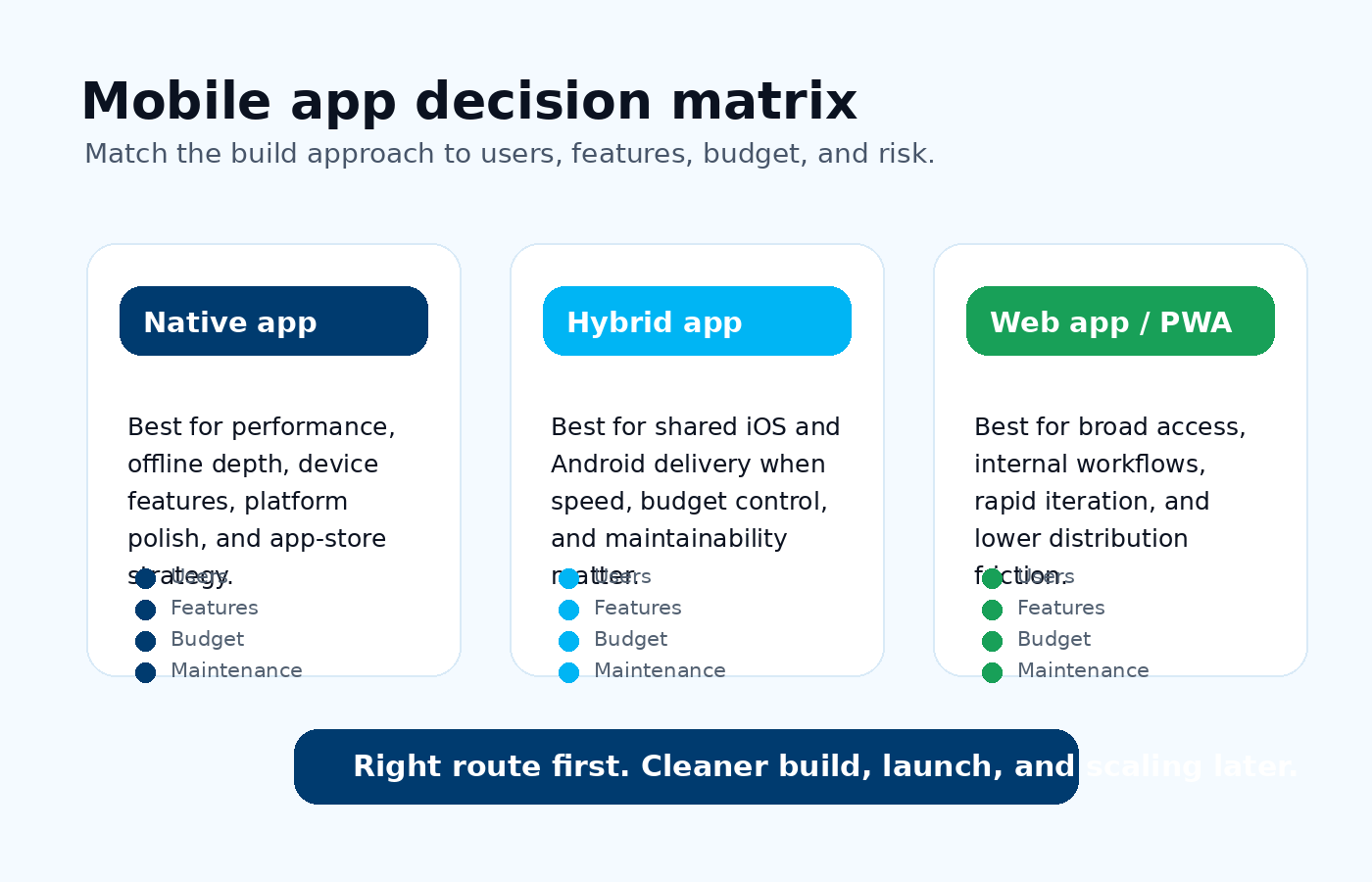
UK businesses should choose native mobile apps when performance, device features, offline reliability, or app-store presence matter most. Hybrid apps suit faster cross-platform delivery with shared code. Web apps or PWAs are best when reach, lower maintenance, and rapid iteration matter more than deep device integration.
The right app starts with the workflow, not the framework
Many app projects go wrong because the technology choice is made before the business case is clear. A restaurant loyalty app, a field-service inspection tool, a healthcare booking portal, and a B2B customer dashboard all have different user habits, risk levels, integrations, and release expectations.
Forge Cloudify treats mobile app development as product engineering. Before choosing native, hybrid, or web, we map who will use the app, how often they will use it, which device features are essential, what data must sync, which systems it must connect to, and how the business will maintain it after launch.
Six decision factors before you build
User behaviour
If people use the product daily on the move, an installable app may be worth it. If use is occasional, account-based, or admin-heavy, a responsive web app may remove unnecessary friction.
Device features
Camera scanning, biometrics, GPS, Bluetooth, push notifications, background work, and offline storage can push the decision toward native or a carefully planned hybrid app.
Performance needs
Real-time interfaces, media-heavy flows, complex gestures, maps, or high-volume local data need more technical care than a simple content or booking experience.
Launch speed
A hybrid app or web app can often validate the market faster. Native can still be the right route when the first release must feel deeply integrated with iOS and Android.
Maintenance
The long-term cost is not just the first build. Plan updates, operating system changes, browser changes, app-store reviews, security patches, analytics, and support workflows.
Integrations
Most business apps depend on APIs, CRM, ERP, payments, identity, notifications, dashboards, or AI features. The app architecture should make those connections reliable.
What a business app plan should include
Forge Cloudify’s app development process
The strongest mobile products are planned around user value and operational reality. The build route should make the product easier to launch, maintain, and improve, not just easier to quote.
Discovery and product map
We define user groups, workflows, integrations, constraints, release goals, and the minimum useful version that can prove business value.
Architecture decision
We compare native, hybrid, and web routes against performance, device features, timeline, cost, maintainability, security, and future roadmap.
Design and build
We create clean mobile UX, reliable APIs, tested features, analytics, authentication, admin tools, and deployment workflows that fit the chosen route.
Launch and improve
We support testing, release, monitoring, app-store readiness where needed, feedback loops, and the next feature cycle after real users start using the product.
Native vs hybrid vs web app comparison
| Approach | Best fit | Watch-outs |
|---|---|---|
| Native app | High-performance consumer apps, offline-first field tools, hardware-heavy workflows, platform-specific UX, and products where app-store presence is important. | Higher cost, separate platform skills, longer release cycles, and more maintenance across iOS and Android. |
| Hybrid app | Cross-platform business apps, MVPs, customer portals, booking tools, internal workflows, and products where shared code helps delivery speed. | Needs careful architecture when native modules, heavy animations, offline sync, or platform-specific behaviour become important. |
| Web app or PWA | Dashboards, portals, SaaS products, internal systems, lead tools, customer accounts, and apps that should be reachable through a browser immediately. | Some mobile features and install behaviours vary by platform; app-store discovery may not be the main route. |
When a phased approach is smarter
A business does not always need to choose one route forever. A practical path might start with a responsive web app to validate the workflow, add PWA features for mobile users, then build a native or hybrid app once usage proves that installability, push notifications, offline sync, or device features will create measurable value.
This avoids spending heavily on app-store packaging before the product model is proven. It also helps UK businesses gather real user feedback, refine integrations, and make the app investment around evidence instead of assumption.
Need help choosing the right app route?
Forge Cloudify can turn your app idea into a clear delivery plan, compare native, hybrid, and web options, design the MVP, build the product, and connect it to the systems your business already depends on.
Frequently asked questions
What is the best type of mobile app for a business?
The best type depends on the job the app must do. Native apps are strongest for demanding device-led experiences, hybrid apps are useful for faster iOS and Android delivery, and web apps are often best for internal tools, customer portals, and products that need broad access.
Is a hybrid app cheaper than a native app?
A hybrid app can reduce build and maintenance cost because one shared codebase can serve iOS and Android. It is not automatically cheaper if the product needs complex native modules, advanced performance, heavy offline behaviour, or platform-specific design polish.
Can a web app work like a mobile app?
A modern web app or PWA can be responsive, installable, fast, and useful on mobile devices. It can feel app-like for many business workflows, but some device features, app-store discovery, push behaviour, and offline depth can vary by platform and browser.
Should a UK business build an app before a web portal?
Usually, build the channel that matches user behaviour first. If customers or staff need frequent mobile access, alerts, scanning, location, or offline work, an app may be justified. If the workflow is occasional or admin-heavy, a web portal may be the better first release.
Can Forge Cloudify help choose the right app approach?
Yes. Forge Cloudify can map user journeys, technical requirements, integrations, costs, and launch risks, then recommend whether a native app, hybrid app, PWA, or web application is the strongest route for the business case.
Related services: Software Development, Cloud & DevOps, AI Development, Project Estimate, and All Forge Cloudify Services.