How to Choose the Right Tech Stack for a SaaS Product
Choose a SaaS technology foundation that supports the first release, the next funding conversation, and the scale decisions that come after real customer traction.
Direct answer: how should you choose a SaaS tech stack?
The right SaaS tech stack is the one your team can build, secure, maintain, integrate, and scale around the product's real commercial needs. Choose technologies by user experience, data model, integrations, compliance, hiring market, speed of delivery, cost, and the roadmap rather than trend popularity.
Why the SaaS tech stack decision matters
A SaaS product is an operating platform, not a login screen with a few pages behind it. It has to onboard users, protect account data, process payments, connect to other tools, release improvements, recover from failure, and stay understandable as the team grows. The tech stack shapes all of that.
The wrong decision rarely looks wrong in week one. It usually appears later as slow feature delivery, fragile integrations, expensive hosting, limited reporting, security gaps, or a hiring market that does not match the tools. Forge Cloudify’s view is practical: choose technology for the product you are building, the team that will operate it, and the commercial stage you need to reach next.
Six decisions behind a strong SaaS tech stack
Product experience
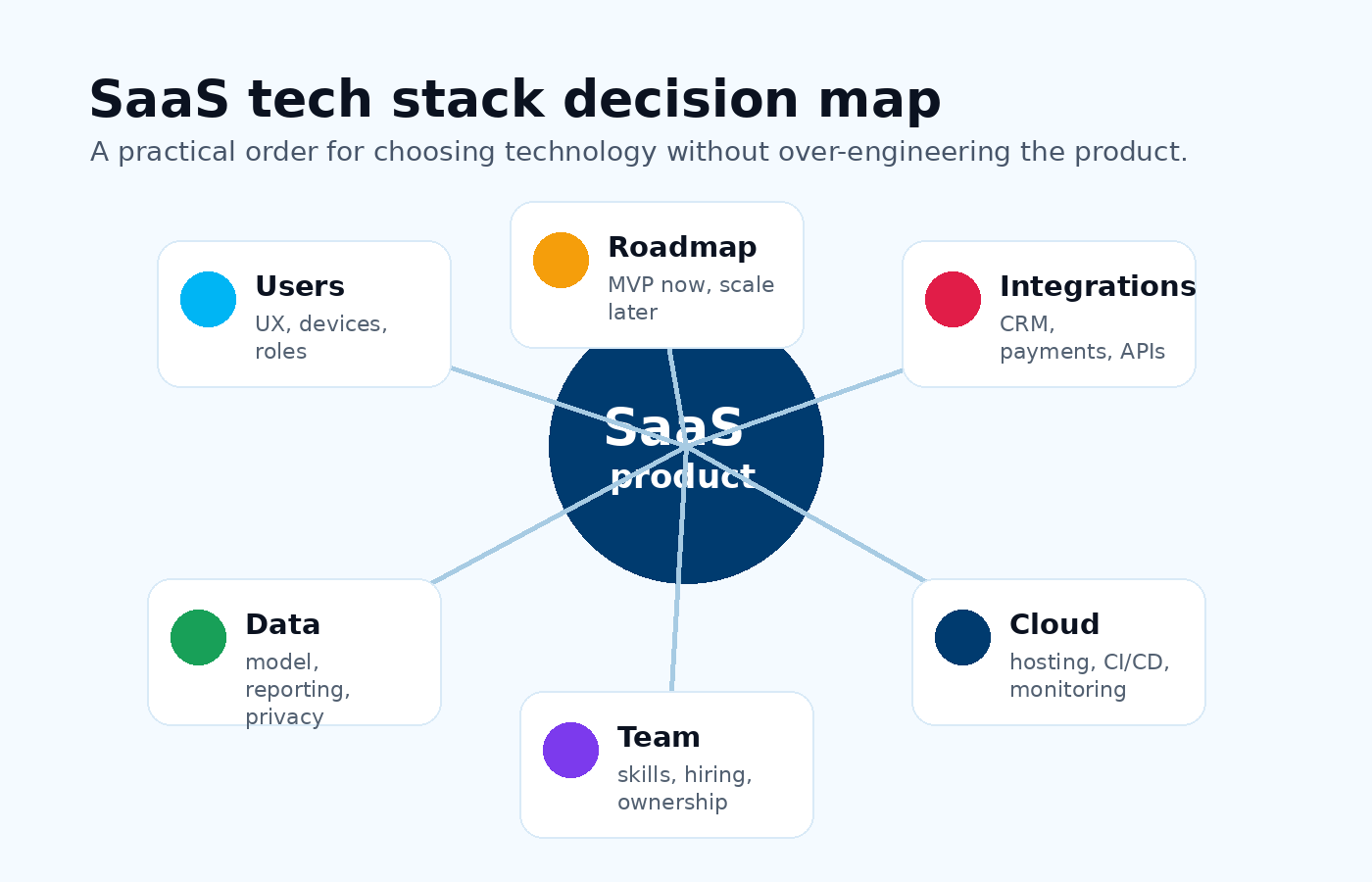
Start with the user journey. A real-time collaboration tool, booking platform, analytics dashboard, marketplace, and AI SaaS product can all need different frontend, backend, and data choices.
Backend shape
Decide how business logic, APIs, permissions, background jobs, billing, and admin workflows should be structured. A modular monolith is often faster and cleaner than early microservices.
Data model
Choose storage around the data that matters: accounts, subscriptions, audit trails, files, search, reports, events, and privacy needs. Database decisions become expensive to reverse later.
Integrations
Most SaaS products need payments, email, CRM, analytics, identity, support, or sector-specific APIs. The stack should make integrations reliable rather than treating them as afterthoughts.
Cloud operations
Hosting, CI/CD, monitoring, logs, backups, alerts, and secrets management are part of the stack. A product that cannot be deployed and observed cleanly will slow down quickly.
Team ownership
Technology should match available skills, hiring plans, budget, and maintenance reality. A fashionable stack is a poor choice if the business cannot operate it confidently.
SaaS tech stack checklist before you commit
Forge Cloudify’s process for choosing a SaaS stack
A good stack decision is a product decision, not a list of favourite frameworks. We normally start with the commercial goal, define the first working version, identify operational risks, and then choose a stack that can carry the product through launch and the next stage of growth.
Define the product workload
We map users, permissions, workflows, data, reporting, integrations, AI needs, and expected usage patterns before talking about frameworks.
Choose the simplest strong foundation
We select frontend, backend, database, cloud, and tooling choices that can ship quickly while keeping security, maintainability, and scale paths visible.
Design delivery operations
We plan deployment, environments, testing, monitoring, backups, secrets, and release ownership so the product can improve after launch.
Review as the product proves itself
As customers use the SaaS product, we use real evidence to decide when to improve performance, split services, add queues, strengthen reporting, or optimise costs.
Popular SaaS stack choices compared
| Approach | Where it works well | Watch-outs |
|---|---|---|
| Full-stack JavaScript or TypeScript | Fast product teams, shared frontend/backend skills, rich web apps, APIs, dashboards, and modern SaaS MVPs. | Needs discipline around architecture, testing, background jobs, and security boundaries as complexity grows. |
| Python backend with modern frontend | Data-heavy SaaS, AI features, automation, analytics, internal tools, and products where Python ecosystem speed matters. | Frontend/backend coordination, async workload design, and deployment patterns should be planned early. |
| .NET, Java, or enterprise stack | Regulated environments, enterprise integrations, larger teams, complex domain logic, and long-lived business systems. | Can be slower or heavier for a lean MVP if the product does not need enterprise structure yet. |
| Low-code or no-code foundation | Early validation, internal workflow tools, simple portals, and prototypes where speed matters more than deep custom logic. | May hit limits around ownership, complex integrations, performance, custom UX, tenant isolation, or exportability. |
What not to over-engineer too early
Early SaaS teams often feel pressure to choose microservices, Kubernetes, event streaming, complex multi-cloud setups, or a fashionable database before the product has real usage. Those tools can be valuable, but they should answer specific problems. In many cases, a well-built modular application, managed database, clean API design, automated deployments, and practical monitoring will take the product much further than a complicated architecture diagram.
The goal is optionality. Keep the first version simple enough to ship, but structured enough that the business is not trapped. That balance is where good SaaS architecture earns its value.
Need help choosing the right SaaS stack?
Forge Cloudify can help you plan the architecture, MVP scope, integrations, cloud foundation, and delivery roadmap for a SaaS product that needs to launch cleanly and grow sensibly.
Frequently asked questions
What is a SaaS tech stack?
A SaaS tech stack is the set of technologies used to build and run a software-as-a-service product. It usually includes the frontend, backend, database, cloud hosting, authentication, payments, analytics, monitoring, deployment tools, and integrations.
What is the best tech stack for a SaaS MVP?
The best SaaS MVP stack is usually a proven, well-supported stack your team can ship quickly and maintain confidently. For many products that means a modern web frontend, a reliable backend framework, a managed database, cloud hosting, CI/CD, and only the integrations needed for the first commercial workflow.
Should a SaaS product use microservices from the start?
Not usually. Most early SaaS products are better served by a modular monolith or simple service structure until customer load, team size, domain boundaries, or reliability needs justify microservices. Premature service splitting often slows delivery and increases DevOps overhead.
How much does the tech stack affect SaaS cost?
The stack affects build cost, hosting cost, hiring cost, maintenance cost, and future change cost. A cheaper tool can become expensive if it creates slow delivery, weak security, limited integrations, or a shortage of developers who can support it.
Can Forge Cloudify help choose and build a SaaS stack?
Yes. Forge Cloudify helps founders and businesses choose practical SaaS architecture, build MVPs, plan integrations, set up cloud infrastructure, and create a roadmap that keeps the product maintainable as it grows.
Related services: Software Development, Cloud & DevOps, AI Development, Project Estimate.