AI Agents vs AI Chatbots: What Should a Business Build First?
AI chatbots and AI agents can both improve business workflows, but they solve different problems. The smart move is to build the smallest useful system first, then add autonomy only where the business case is clear.
Direct answer: what should a business build first?
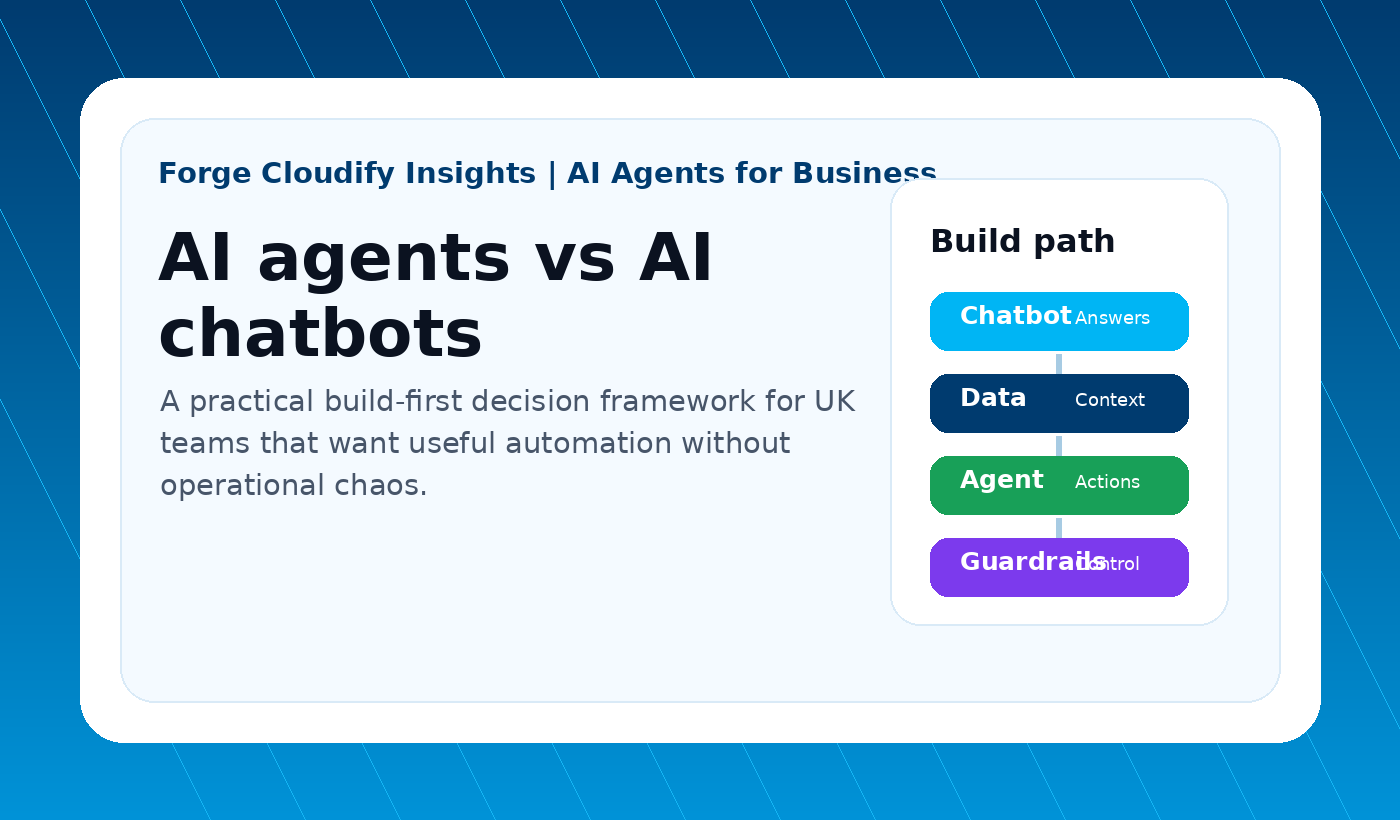
Most businesses should build an AI chatbot first when the goal is faster answers, lead capture, or support triage. Build an AI agent first only when the workflow needs secure tool access, decisions, approvals, and measurable task completion. The best route is often a chatbot foundation that grows into agentic automation.
Why this decision matters now
AI agents are attracting attention because they can move beyond conversation into action. Research from IBM describes agents as systems that can autonomously perform tasks by designing workflows with available tools, while business platforms such as Microsoft and Salesforce are pushing agentic AI into operational processes and customer experience.
That does not mean every company should jump straight to autonomous agents. A poorly scoped agent can create more review work, more exceptions, and more governance risk than a focused chatbot. Forge Cloudify’s view is practical: start where AI can remove friction, prove value, and stay controlled.
Six signals that tell you what to build
Conversation only
If users mainly need answers, guidance, FAQs, service explanations, or lead capture, a chatbot is usually the right first build. Keep it accurate, helpful, and easy to hand over to a human.
Task completion
If the system must check data, create records, route tickets, prepare summaries, trigger workflows, or update tools, you are moving toward an AI agent or agent-assisted workflow.
Data quality
Chatbots can work with a curated knowledge base. Agents need cleaner operational data, reliable APIs, defined rules, and clear ownership because they affect real systems.
Risk level
The higher the impact of a wrong action, the more you need approvals, limits, logs, and fallback paths. Finance, legal, customer records, and fulfilment workflows need extra control.
Integration depth
A chatbot may live on a website or WhatsApp. An agent usually needs CRM, helpdesk, calendar, ERP, payment, email, document, or cloud integrations to create real value.
Measurable outcome
Build the option that has a clear metric: fewer repeated questions, faster response time, better lead quality, reduced admin hours, fewer missed follow-ups, or improved customer satisfaction.
Build-first checklist for AI automation
Forge Cloudify’s recommended build path
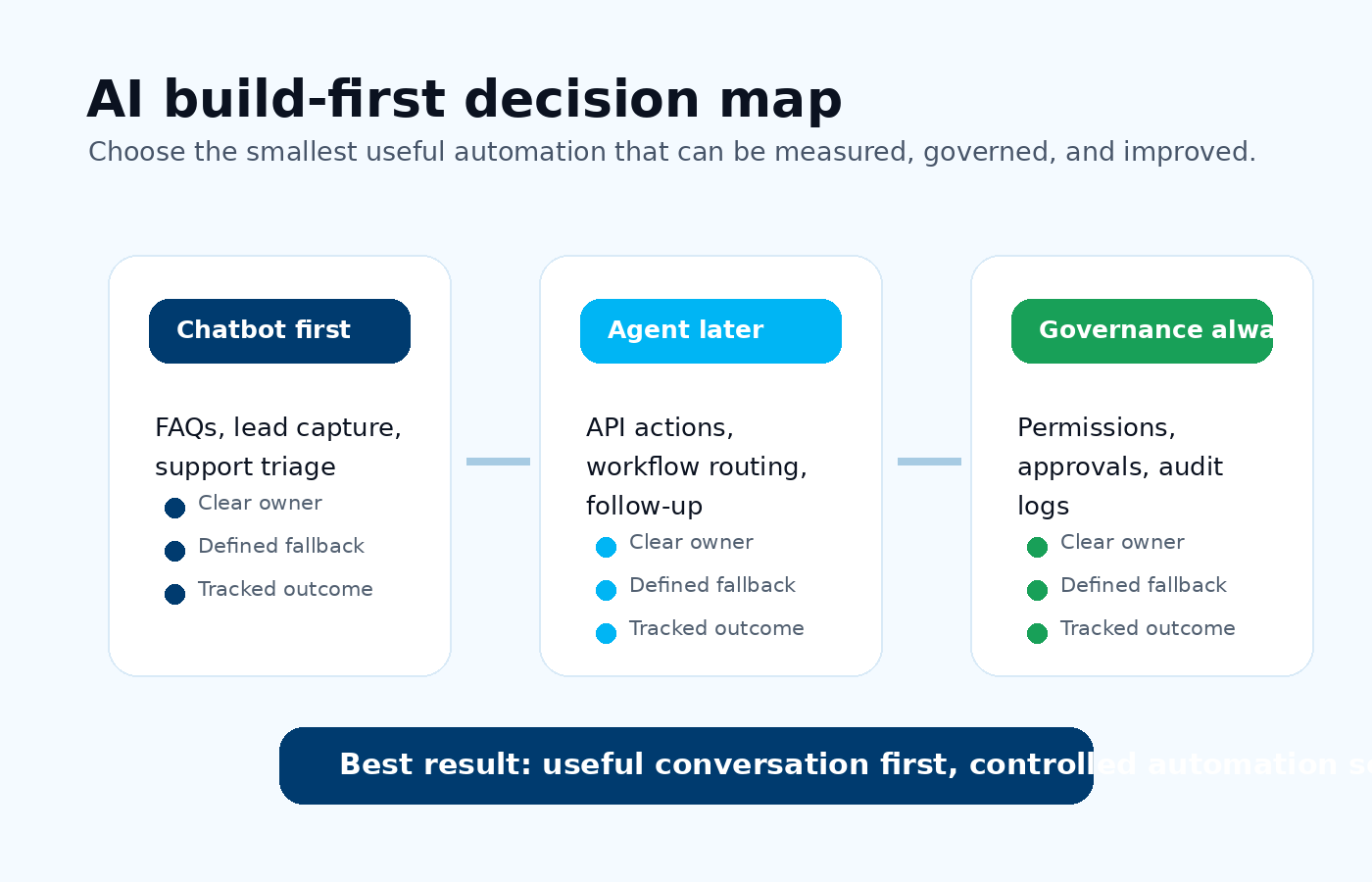
For most UK businesses, the strongest AI roadmap starts with a controlled assistant and grows into action-taking automation. This keeps cost, risk, and expectations manageable while still building toward agentic capability.
Map the workflow
Identify the repetitive questions, admin steps, customer journeys, internal handoffs, systems, and decisions involved. Separate simple conversation from tasks that require action.
Launch a useful chatbot
Build a focused chatbot for support, lead qualification, service guidance, booking requests, or internal knowledge retrieval. Use real business content, not generic filler.
Add controlled actions
Connect safe actions first: create a ticket, draft a CRM note, send a summary, collect missing details, or prepare a quote for review. Keep approval gates where mistakes would matter.
Operationalise the agent
Add monitoring, permissions, test cases, logs, fallbacks, analytics, retraining cycles, and team ownership so the system behaves like dependable business software.
AI chatbot vs AI agent comparison
| Decision area | AI chatbot first | AI agent first |
|---|---|---|
| Best use case | Website FAQs, support triage, lead capture, onboarding guidance, internal knowledge search. | Multi-step workflows, CRM updates, ticket routing, document handling, follow-up automation, system actions. |
| Complexity | Lower. Needs good content, conversation design, analytics, and handover. | Higher. Needs APIs, permissions, workflow logic, monitoring, governance, and stronger testing. |
| Risk profile | Lower if it only advises, collects details, or routes users. | Higher because it can affect records, customers, operations, and decisions. |
| When to choose | Choose this when the business has repeated questions or poor intake but limited automation readiness. | Choose this when the workflow is well defined, high value, integration-ready, and safe to automate in stages. |
Cost and readiness considerations
A chatbot project is often the faster route because the first version can be limited to knowledge, intake, routing, and analytics. The main costs are content preparation, conversation design, channel integration, testing, and maintenance.
An agent project needs a wider software mindset. Budget for API integrations, cloud architecture, authentication, permissions, test environments, human approval flows, audit logs, data handling, prompt and tool evaluation, monitoring, and support. The return can be higher, but only when the process is valuable enough to automate properly.
Need help choosing the right AI build?
Forge Cloudify can help you decide whether your first AI project should be a chatbot, agentic workflow, internal assistant, API integration, or wider automation roadmap, then build it with the right software foundation.
Frequently asked questions
What is the difference between an AI chatbot and an AI agent?
An AI chatbot mainly holds a conversation, answers questions, collects information, or guides a user through a defined path. An AI agent can plan steps, use tools, call APIs, update systems, and complete a task with guardrails and human approval where needed.
Should a small business start with a chatbot or an AI agent?
Most small businesses should start with a focused chatbot if the main problem is repetitive questions, lead qualification, appointment requests, or support triage. Start with an AI agent only when the task has clear rules, clean data, secure integrations, and enough value to justify extra governance.
Are AI agents more expensive than chatbots?
Usually yes. AI agents need more design, integrations, permission controls, testing, monitoring, fallback handling, and maintenance. A chatbot can often launch faster, while an agent should be treated like operational software that touches real systems.
Can a chatbot become an AI agent later?
Yes. A chatbot can become the front door for an agentic workflow. Once the conversation layer is useful, you can add CRM lookup, ticket creation, quote preparation, document processing, workflow routing, and approval-based actions in stages.
Can Forge Cloudify build AI agents and chatbots?
Yes. Forge Cloudify can design AI chatbots, agentic workflows, API integrations, cloud infrastructure, data preparation, security controls, and the software layer needed to make AI automation useful inside a real business.
Related services: AI Development, Software Development, Cloud & DevOps, Project Estimate, and All Services.